Tipalti Supplier Portal Onboarding and Payment Setup
Suppliers must complete tax forms and banking details before the first payment clears.

Tipalti's supplier portal runs on one rule: nobody gets in without an invite, and nobody gets paid without clearing tax and banking checks first. This piece walks through that flow start to finish, registration, tax forms, payment setup, bank validation, so both sides of the transaction know where the friction actually lives.
Tipalti's supplier portal and its intended users
The Supplier Hub is a self-service portal where payers collect business information, tax forms, banking details, and payment preferences from vendors, and none of it happens after the fact. Every field gets filled in before a single invoice moves through the system.
That "before" affects how the system is built: every step is built around one outcome. This isn't a filing cabinet where vendor names sit next to phone numbers. Every step is built around one outcome: making the supplier payable, correctly, the first time.
The portal handles a wide range of payees, raw material vendors, utility companies, independent contractors, even employees, and calls all of them "suppliers" regardless of what the payer calls them internally. WETA, for instance, uses "vendor" in its own systems but adopted Tipalti's "supplier" language for the platform itself. Semantics, sure, but it's worth knowing before you're searching the wrong term in a help doc.
Payers can host the portal on Tipalti's own domain or embed it directly into their website, white-labeled so it looks like part of the company's existing systems rather than a bolted-on third-party tool. A supplier filling out their W-9 shouldn't feel like they've wandered into someone else's app.
Manual onboarding (collecting documents by email, chasing tax forms, and verifying bank details by hand) is where AP teams lose hours and where compliance gaps open. The portal exists specifically to close that gap before the money moves, not after.
The invite-driven registration flow, from the payer's first action to supplier approval
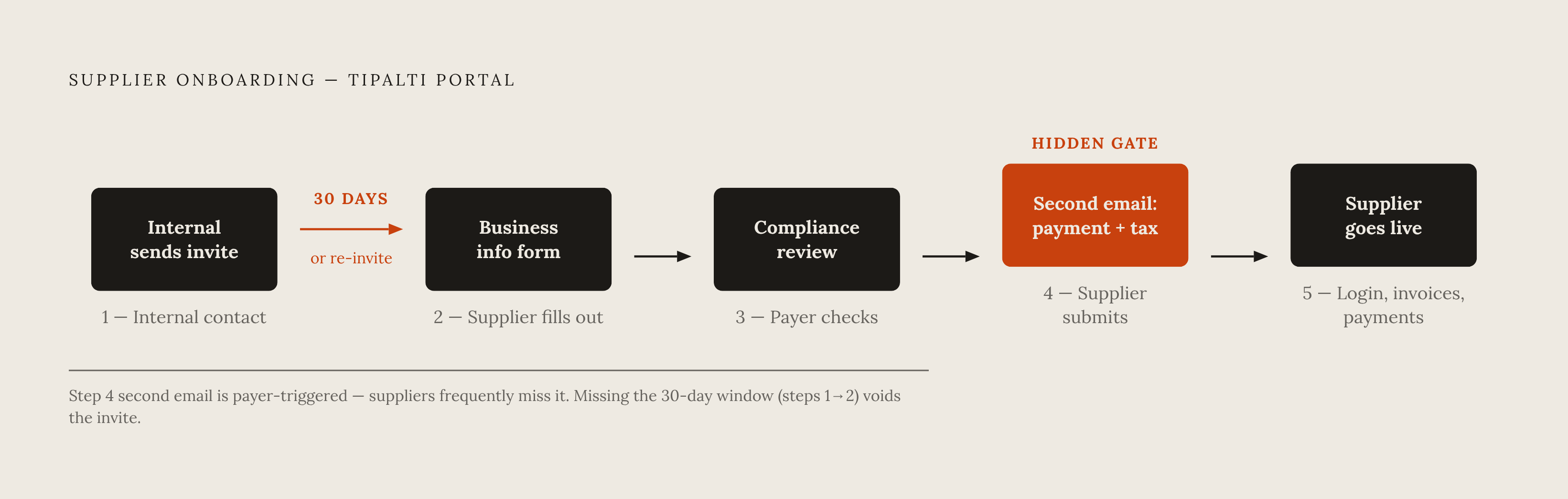
Nothing starts until a payer sends the invite. Suppliers cannot register on their own initiative, full stop. Once that invitation lands in their inbox, they've got 30 days to complete registration before the link expires, which is either a generous window or a ticking clock depending on how organized the supplier's accounting person happens to be.
WETA and NewsHour Productions LLC made this mandatory starting July 1, 2025: every new supplier needs a WETA contact to send the invite, no exceptions, no self-service sign-ups. It's a clean, traceable audit trail from the payer's very first action.
The sequence itself runs in five steps. First, an internal contact at the paying company, whoever ordered the goods or manages that relationship, sends the Tipalti invite. Second, the supplier opens the email, clicks the link, and starts filling out Business Info sections that the payer has configured to match their own requirements. Third, the payer reviews what came in, and depending on internal policy, may run security or compliance checks before signing off. Fourth, once approved, the supplier gets a second email prompting them to submit payment method and tax details. Fifth, the supplier goes live: an active payee who can log in anytime, upload invoices, and track payments.
WETA built in a practical carve-out for its rollout too. Existing suppliers were to be invited "over the next several months," but that phased timeline wouldn't stop business from continuing through Tipalti in the meantime. Useful precedent for any payer worried that a slow migration means frozen operations, it doesn't have to.
Suppliers who were originally set up through some other method, before this Tipalti flow existed, have to re-enter their full details once to make the initial connection. After that first full pass, updates only require the fields that actually changed. Annoying once, painless after.
Tax form collection and compliance validation built into the onboarding sequence
Tax forms get collected during onboarding, not chased down weeks later once someone in accounting notices the file is empty. Domestic suppliers fill out a W-9; foreign suppliers get routed to whichever of the W-8 family fits their situation, W-8BEN, W-8BEN-E, W-8EXP, W-8IMY, W-8ECI, plus W-4 or Form 8233 where applicable. A tax wizard walks each supplier to the right form based on their own profile, so nobody's guessing which W-8 variant applies to a foreign contractor versus a foreign corporation.
IRS TIN matching runs automatically against submitted details to flag mismatches before they cause backup withholding penalties.
The scale of validation here is genuinely large: over 1,000 rules inside the tax wizard alone, and a broader compliance engine running more than 3,000 rules across the whole platform. KPMG has reviewed and approved the process against IRS requirements, which matters if an auditor ever asks how confident the company is in its own paperwork.
International tax gets its own lane. EU businesses submit VAT IDs during onboarding, and the platform validates them, with supplier tax ID collection supported across more than 60 countries Best-in-Class Solution for Managing Supplier Relationships. That's not a small footprint, and it's the kind of detail that saves a multi-entity company from building separate spreadsheets per region.
Timing matters here too, and it's shifting. The 1099 reporting threshold sat below $600 per calendar year through December 31, 2025 Best-in-Class Solution for Managing Supplier Relationships. Starting in 2026, the One Big Beautiful Bill Act raises that threshold to below $2,000 for non-employee payments, with future years adjusted for inflation Best-in-Class Solution for Managing Supplier Relationships. Tipalti's reporting infrastructure is built to absorb that change automatically, which spares finance teams from manually recalculating thresholds every filing season Best-in-Class Solution for Managing Supplier Relationships.
Payment method selection and bank detail validation
Once tax forms clear, the supplier picks how they want to get paid, and this choice belongs to the supplier, not the payer, within whatever options the payer has turned on. Over 50 global and local payment methods are supported in total Tipalti Reviews 2026: Details, Pricing, & Features | G2.
Suppliers also pick their preferred currency and can set a payment threshold, so the payer funds everything in local currency while Tipalti handles the FX conversion and remittance behind the scenes. No extra bank accounts to open, no manual currency math. The geographic reach backs that up: more than 200 countries and territories, 120 currencies.
A small but clever incentive is built into the cost structure. Payers can pass transaction costs onto suppliers, which nudges suppliers toward the cheapest payment method available to them rather than defaulting to whatever's most familiar. Over time, that shifts the whole supplier base toward lower-cost rails without anyone having to mandate it.
Validation on the banking side runs deep. SWIFT and IBAN codes get checked against format rules before anything moves, and a rules engine with 26,000 global rules catches problems before a payment ever executes Best-in-Class Solution for Managing Supplier Relationships. OFAC sanctions screening runs on every payment cycle too, not a one-time onboarding check. The combined effect, per Tipalti's own reported figures, is a cut in payment errors of more than 66%. That's not a rounding error; it's the difference between chasing down a bounced wire and never hearing about it. SEPA is an expansion of Global ACH for Euro-area countries, enabling direct bank transfers at lower cost.
Tipalti operates as a regulated Money Services Business and holds U.S. Money Transmitter Licenses in every state that requires one, which is the kind of regulatory box that finance and legal teams want checked before they trust a platform with international payroll-adjacent money. ACH (automated clearinghouse) is offered as a domestic U.S. payment method. Global ACH / eCheck serves as the international equivalent payment method.
Supplier capabilities inside the portal after setup
Once active, a supplier's relationship with the portal doesn't end, it just changes shape. They can upload invoices through email as a PDF, direct portal upload, or EDI feeds, and check status, payment history, and their own profile without picking up the phone.
That last part is the real win for the AP team on the other end. Self-service means payment-related inquiries drop substantially, suppliers get their answers from the portal instead of calling or emailing AP. Reviewers on G2 in 2026 note that duplicate payments dropped to nearly zero once suppliers started managing their own records, because the people with the most motivation to keep bank details accurate are the ones actually getting paid with them.
Language support matters more than it gets credit for. Onboarding runs across 27 languages, so a supplier in another country gets a form they can actually parse instead of one that leaves them squinting. On the payer's side, invoice capture uses OCR with line-item extraction, pulling vendor name, invoice number, amount, GL codes, and line-level detail straight into the AP workflow. What the supplier submits and what the payer's system needs end up connected automatically, without someone retyping numbers from a PDF into a spreadsheet.
Tipalti's onboarding connection to the broader AP and ERP workflow
None of this onboarding exists in isolation. It's the front door into a full AP automation workflow, not a standalone registration exercise that dead-ends once the supplier's approved. Invoices from an onboarded supplier flow directly into 2-way or 3-way PO matching, and approval routing plus payment scheduling both run through the same system.
The downstream effect on financial close is one of the bigger payoffs here. One company reported in G2 reviews cutting AP close from 6-7 days down to 1-2 days. Tipalti connects to NetSuite, Sage Intacct, QuickBooks, Xero, Microsoft Dynamics 365 Business Central, Acumatica, and SAP-related environments, positioning itself as a payment automation layer that extends an existing ERP rather than replacing it, with financial close improving by 25% according to G2 data.
A real friction point deserves to be named here. Payments made outside of Tipalti don't sync back into the ERP automatically, which means Tipalti's aging report can drift away from the actual state of AP aging, and someone ends up reconciling by hand. G2 reviewers flagged this repeatedly in 2026, and it's a genuine consideration for any team running a hybrid setup where some payments go through Tipalti and others don't.
Beyond invoices, Tipalti has pushed into purchase order workflows and PO matching, which makes the whole supplier relationship more durable across the entire procurement cycle rather than just the payment moment. Tax ID collection across more than 60 countries, paired with onboarding that's customizable per entity, gives multi-entity companies a way to handle the fact that each subsidiary might answer to different regional compliance rules.
Measured outcomes from teams that have run this onboarding flow
The numbers from actual deployments are specific enough to repeat in full. One G2 reviewer in 2026 cut invoice processing time from roughly 30 minutes down to about 5 minutes, an 83% reduction, saving more than $60,000 annually. At that same company, weekly AP workload dropped from around 50 hours spread across three people to about 25 hours handled by a single analyst Tipalti Reviews 2026: Details, Pricing, & Features | G2. That's not a small efficiency gain, but an entire role's worth of work absorbed elsewhere.
League One Volleyball used Tipalti's NetSuite integration to cut invoice processing time by 75% across more than 90 entities. Tapjoy cut its payment workload by over 50% while improving developer satisfaction through faster, more flexible payment options Tipalti Reviews 2026: Details, Pricing, & Features | G2 Tipalti. Thematic managed to cut the need for three team members entirely by automating global payments, streamlining artist onboarding and royalty payments through the self-service portal.
Platform-wide, Tipalti holds a 4.5 out of 5 rating across 424 reviews on G2 as of 2026, with 74% five-star ratings and another 20% at four stars. Tipalti itself reports 98% customer satisfaction.
Where setup delays and errors typically come from
The 30-day registration window is not a suggestion but a hard deadline, and a supplier who misses it needs an entirely new invitation. Payers who want to avoid that back-and-forth should communicate urgency clearly at the moment they send the invite, and follow up if registration stalls partway through.
A steep learning curve is the single most common complaint across G2, TrustRadius, Capterra, GetApp, and Software Advice, especially during initial implementation. That's not a knock on the product so much as an honest description of what onboarding a full finance automation platform involves: there's real depth here, and depth takes time to learn.
The ERP sync gap mentioned earlier deserves a second look from a practical angle. Any team running a hybrid payment flow, some transactions through Tipalti, some outside it, needs a clear internal rule about which payments go where, or the aging report stops reflecting reality. Pick one system as the source of truth and stick to it.
Fit matters too, and treating it as a training gap misses the point. Tipalti is built for enterprises managing large, international supplier bases, and for a smaller or simpler AP operation, that depth of functionality can feel like using a freight truck to deliver a birthday card. That's a scope question, not a competence question.
On the invoice side, avoiding payment holds comes down to a checklist that WETA spells out clearly in its supplier guidance. Company name, doing-business-as name where relevant, a unique invoice or document number, invoice date, a description of the goods or services, quantity, price, remittance address (yes, even for ACH payments, a detail that trips people up constantly), and the name or department of the contact at the paying organization. Missing or duplicate invoice numbers are the single most common reason invoices get flagged and blocked, and while the platform catches the duplicate, it's still on the supplier to fix and resubmit.
The same connection applies to any payer who handles both sides of the ledger. The same transparency that cuts down supplier payment questions on the AP side works just as well in reverse for receivables. When customers can see invoice and payment status in real time, the phone stops ringing on that side of the business too.
Sources
- Tipalti | WETA
- Tipalti Reviews 2026: Details, Pricing, & Features | G2
- Streamline Supplier Onboarding | Tipalti
- Best-in-Class Solution for Managing Supplier Relationships
- Mass Payments Solution: Pay Global Partners & Suppliers | Tipalti
- Set up payee onboarding via iFrame – Tipalti
- Payee workflow – Tipalti
- Supplier Hub – Tipalti