W-9 Collection as an AR Bottleneck
Missing W-9s delay vendor payments before AR teams even start collecting.

Missing W-9s don't just annoy the tax team. They stall payments before an invoice ever ships. DSO starts climbing before collections even gets a chance to do its job. HighRadius benchmark data shows DSO already up 9.5% in 2026, with 60% of a national market's CFOs pushing AR to the top of their priority list. Most of that attention goes toward chasing late payers. Turns out the leak often starts one step earlier, in the pile of tax forms nobody wanted to deal with.
A single big supplier relationship can require sign-off from legal, finance, procurement, and IT before a payment ever processes. Adding a missing or messy W-9 to that chain makes the runway longer. This is a cash flow problem wearing a paperwork costume, and finance teams who keep treating it as an administrative afterthought are the ones stuck absorbing the bill.
What a W-9 does in a payment relationship
Form W-9, officially "Request for Taxpayer Identification Number and Certification," is not a formality. It collects a payee's legal name, tax classification, and taxpayer identification number, the exact data a payer needs to file information returns like the 1099-NEC and to figure out whether backup withholding kicks in.
Without a valid one on file, a payer can be on the hook to withhold 24% of every single payment to that vendor, nearly a quarter of the invoice gone before the vendor ever sees a dime, and send it straight to the IRS. Without a valid one on file, a payer can be on the hook to withhold 24% of every single payment to that vendor, nearly a quarter of the invoice, and send it straight to the IRS. That's nearly a quarter of the invoice, gone, before the vendor ever sees a dime.
The form doubles as a payer's paper trail in an audit. Even payments to corporations, which are typically exempt from 1099-NEC reporting, still need a signed W-9 showing the vendor checked "C-Corporation" or "S-Corporation." Skipping that step frees an auditor to treat the payee as an unincorporated entity and assess penalties against the payer, not the vendor. Best-in-class accounting teams require a signed W-9 from every vendor, full stop, applied as a universal intake requirement. Not the big ones. Not the risky ones. Every one.
How the 2026 regulatory environment changed W-9 stakes
A federal tax law (signed July 4, 2025) raised the 1099-NEC and 1099-MISC reporting threshold from $600 to $2,000 for payments made on or after January 1, 2026, under Section 70433, and that number now adjust... L. 119-21, signed July 4, 2025) raised the 1099-NEC and 1099-MISC reporting threshold from $600 to $2,000 for payments made on or after January 1, 2026, under Section 70433, and that number now adjusts for inflation going forward. Same law made the 24% backup withholding rate permanent, closing the door on a reversion to the old 28% rate that had been floating around since the TCJA took effect in 2018.
It's tempting to stop collecting W-9s from small, infrequent vendors, since plenty of them will now fall below the $2,000 line. Experts warn this is exactly the moment data integrity quietly falls apart. Teams assume a vendor is "too small to matter," skip the form, and end up with a gap they don't notice until a payment history catches up to the new rules or the vendor's volume grows past the threshold mid-year.
A 2026 draft version of Form W-9 is also circulating. The IRS finalized an update in 2024, its first meaningful revision in years, and has since floated 2026 drafts without a second finalized version yet. The direction is clear though: closer alignment with digital asset reporting, which matters most for sole proprietors, single-member LLCs, and digital asset brokers. On top of that, electronic filing is now mandatory for any business filing 10 or more information returns for tax year 2025. A lot of teams who thought e-filing rules didn't apply to them are about to find out otherwise. None of this points toward relaxing W-9 intake in 2026. If anything, the rules reward clean records more and punish gaps harder than they used to.
The backup withholding trap
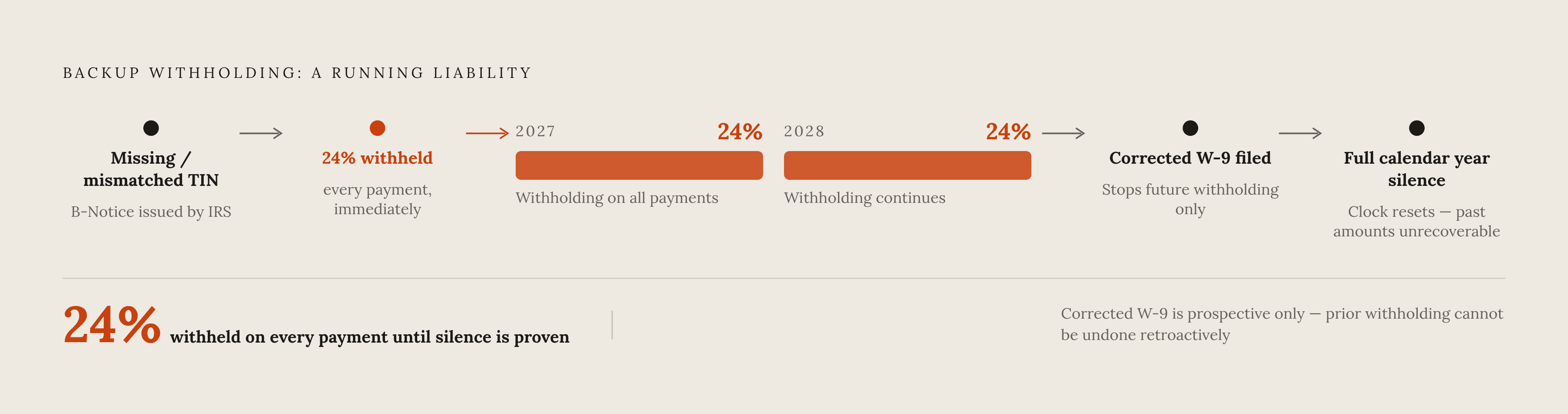
Start with the mechanism, because the mechanism is worse than the headline number. A missing TIN, or a name and TIN that don't match IRS records, triggers what's called a B-Notice. Once that happens, the 24% withholding obligation attaches to every future payment to that vendor.
It's a running position, not a one-time fee. It's a running position. A payee who trips the threshold in 2026 gets withheld on across every payment in 2027, and again in 2028, and the clock only resets after a full calendar year passes with zero reportable payments to that payee. Submit a corrected W-9 and withholding stops going forward, sure. But it does nothing to undo the lookback period that already happened. The compounding already happened. There's no rewind button.
People tend to forget that liability runs in both directions here. If a payer fails to withhold when the rules required it, the payer can be held liable for the full 24% amount, plus fines and interest on top. Penalties for incorrect or late 1099 filings scale steeply too, starting low for a quick correction and climbing toward uncapped territory if the IRS decides the failure was intentional. So the real cost of one missed W-9 was never really about that one form. It's the cost of every single payment made to that vendor until the record gets fixed.
Where W-9 collection breaks down in AR workflows
Every failure mode below traces straight back to a payment delay or a compliance gap. None of these are theoretical.
Name and TIN mismatches are the single most common trigger for a B-Notice, usually because a vendor filled out the form using a trade name instead of their actual legal entity name. That mismatch puts a payment on hold immediately and kicks off the compounding withholding cycle described above. Unsigned or incomplete forms are another classic: an unsigned W-9 carries no legal weight, most payers reject it outright, and backup withholding can start over what amounts to a missing signature. The vendor's clerical slip becomes the payer's liability.
LLC entity ambiguity trips people up constantly. An LLC that doesn't specify whether it's taxed as a partnership, a C corp, or an S corp can't be correctly slotted for 1099 purposes, and payers have to chase that clarification down before the form is even usable. Records also go stale fast: vendors rename themselves, switch entity types, get a new EIN, and the IRS updates the form itself every so often too. File a 1099 against outdated details and the mismatch notice arrives months later, long after the payments already went out the door.
Year-end scrambles make everything worse. Chasing a W-9 in December, or worse, in January after the fact, is a much harder ask when the vendor has already been paid or has moved on to other clients. Missed 1099 deadlines follow, and so do the per-form IRS penalties that come with them. Context makes this sting more: 55% of a national market's B2B invoiced sales already arrive after the due date, per 2025 data from commercialcollectors.com. A W-9 gap that stalls the first payment just pushes that vendor further into the late-pay column before the relationship even has a chance to find its footing.
Healthcare offers a sharp example of the same problem in a higher-stakes setting. A Tax ID mismatch in a medical claim can trigger payment holds at the payer level. Out-of-network providers without contractual payment timeline protections can face extended waits for a reissued check, even after the W-9 correction is done. Same failure mode, just with more zeros and less patience on both sides.
Why "no W-9, no payment" solves the compliance problem but creates an AR one
The standard advice is blunt and, frankly, correct: no completed W-9, no payment. It's a lot easier to get the form out of a vendor who's waiting on a check than one who already cashed it. Some companies take it a step further and won't even onboard or engage a vendor until the tax paperwork is in hand, before a single invoice gets written.
From the vendor's side, that's a hard stop on getting paid. From the payer's AR side, that exact same stop appears as a delayed first receipt, and DSO on that relationship starts inflating from day one, before collections even enters the picture. "Just collect the forms faster" is true, but it's an incomplete answer. The real issue is that the DSO cost of this policy stays invisible as long as W-9 intake gets treated like a compliance chore instead of a front-line AR task.
Plenty of finance teams split W-9 collection off as the compliance team's job and leave invoice follow-up to AR, as if the two never touch. That split builds the delay into the workflow permanently, because nobody owns the exact moment where the two processes are supposed to meet. The fix is recognizing that W-9 intake is an AR function that happens to carry tax consequences, not picking a side between compliance and cash flow. W-9 intake is an AR function that happens to carry tax consequences.
What a front-line W-9 intake process looks like in practice
The form needs to show up at vendor onboarding, not at payment time. Make it a precondition for activating the vendor. That single change is the structural fix for the DSO drag described above.
Validation belongs at intake too. Catch the name and TIN mismatch, the missing signature, the unclear LLC classification, right when the vendor submits the form, not months later when the January 1099 run spits out a stack of errors. Any change to a vendor's legal name, entity type, or EIN should automatically flag a fresh W-9 requirement. Stale data is just as dangerous as missing data, it just feels safer because there's something sitting in the file.
Resist the urge created by the new $2,000 threshold to quietly stop collecting from small or infrequent vendors. Once a team creates an informal exemption class, data integrity problems start compounding somewhere nobody's watching. And when a vendor ignores an automated form request, which happens more than anyone would like, a real human touchpoint usually gets the form back faster than another automated nudge. The same persistence that works in collections works here, because the vendor wants the exact same thing: to get paid. Digital intake, structured fields instead of a scanned PDF, cuts down on the two most common errors (missing signatures and LLC ambiguity) before they even happen. Clean, current records by the third quarter mean no January correction scramble. That scramble is always a symptom of something that should've been handled months earlier.
How AR teams can close the W-9 gap without adding headcount
HighRadius's benchmark report, which drew on data from more than 1,500 customers, found that companies using agentic AI-driven AR technology have seen DSO drop by up to 68%, alongside a 40% boost in productivity. Even if a given team lands somewhere short of it, that's the range to aim for.
W-9 collection belongs on the same list as portal friction, missing purchase orders, and communication breakdowns: unglamorous operational blockers that a well-built AR platform is designed to absorb, rather than a standalone side project handed to whoever has spare time. Look for a few specific capabilities when evaluating what "well-built" actually means here.
Vendor onboarding workflows that require the tax form before activation matter most, since that's the structural fix. TIN validation belongs at intake, not at year-end, to catch mismatches before they ever generate a B-Notice. Re-collection triggers should fire automatically whenever vendor data changes, and follow-up on incomplete forms needs to be persistent and multi-channel, the same follow-up logic that already works for overdue invoices. Integration with procurement portals means W-9 status sits right next to invoice status in the same view instead of living in a separate spreadsheet nobody checks.
Handing W-9 intake to a dedicated AR workflow instead of an ad hoc email thread bouncing between AP, legal, and the vendor makes the structural delay disappear before collections even starts its work. The point was never just compliance. It's removing the drag on DSO that happens before a single invoice goes out, so that when it finally does, the vendor is activated, the paperwork is clean, and the clock starts on day one instead of whenever the form eventually turns up. W-9 collection is the first moment in the AR cycle where cash flow gets protected, or quietly lost. It's the first moment in the AR cycle where cash flow gets protected, or quietly lost.