Payment Reconciliation Process for High-Volume B2B Invoicing
Automating remittance matching cuts manual cash application from coin-flip odds to near-certainty.

B2B ACH volume hit 8.1 billion payments in 2025, up 9.9% year over year. Against that growth, one major bank's Treasury Services Benchmarking survey found 61% of corporate treasury teams now call payment reconciliation their most time-consuming manual process, up from 44% in 2022. Headcount didn't jump 17 points in three years. Volume did, and the process most teams are running was built for a fraction of it.
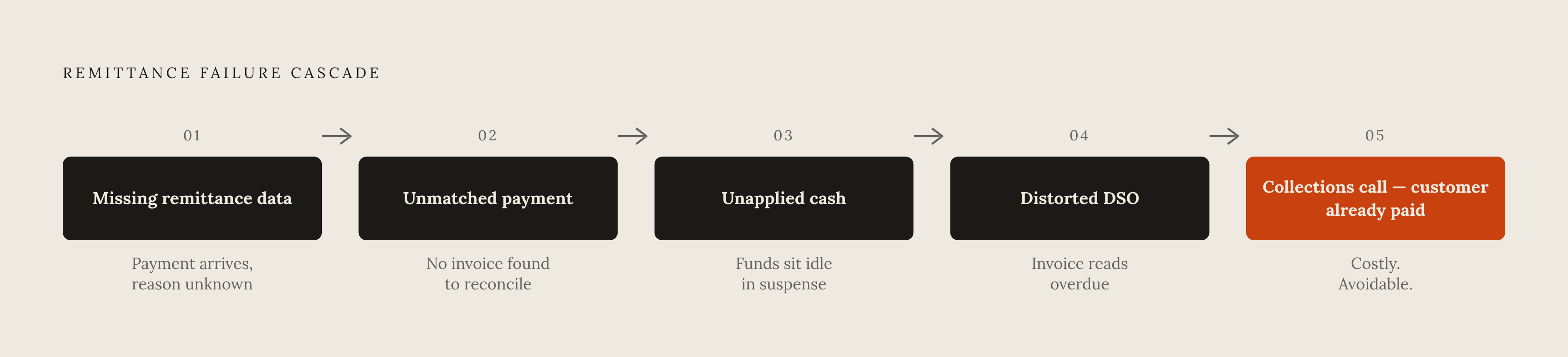
Reconciliation doesn't fall apart because AR teams are lazy or under-resourced. It falls apart because the process has several failure points, and at high volume those points stack instead of staying separate. A gap in remittance data turns into an unmatched payment, which turns into unapplied cash, which turns into a distorted DSO number, which turns into a collections call to a customer who already paid. Each layer feeds the next, and the team that treats all of it as one big blob called "reconciliation" is the team that never fixes any single part of it.
Payment reconciliation, in plain terms, means matching payment records across banks, payment gateways, billing systems, and the general ledger to confirm every transaction actually got recorded and settled. Invoice reconciliation is a narrower cousin: checking invoices against purchase orders, receiving documents, contracts, and payments to confirm nothing got double-billed or missed. What follows walks through where each of these breaks at volume, in order: matching logic, remittance gaps, partial payments and deductions, unapplied cash, portal friction, and then what an actual fix looks like.
Where two-way, three-way, and four-way reconciliation each break
Picking the wrong matching method for the job is like using a butter knife to cut steak. It works eventually. It just takes forever and leaves a mess on the plate.
Two-way matching compares the invoice against the purchase order only. No proof anything got delivered, no proof any service happened. A mismatch between what was ordered and what showed up occurs because two-way matching compares the invoice against the purchase order only, so it is fast and fine for subscriptions or low-dollar buys but gives zero confirmation that what was ordered is what was delivered.
Three-way matching adds a goods receipt or a service acceptance record into the mix. Invoice, PO, and receipt all have to agree on item descriptions, quantities, unit prices, terms, and totals. This is the standard for physical goods, for one simple reason: it checks whether the truck actually showed up.
Four-way matching bolts on another layer of verification for the biggest, riskiest purchases. Which method a company should use depends on purchase type, dollar value, and how much risk the buyer will eat, not on whichever method looks most thorough on paper. Reaching for four-way matching on a subscription renewal is overkill that slows down a clean transaction for no reason, and teams that default to the heaviest option "to be safe" are the ones who end up with the biggest backlogs.
Matching only works as well as the data behind it, and that's the part vendor slide decks skip. Errors accumulate across manually processed invoices, and the inputs feeding the matching step are where most of them originate. A mismatched reference number, an item description typed differently on the invoice than on the PO, or a unit price off by a rounding error becomes visible at the matching step. A shop processing fifty invoices a month catches that in five minutes. A shop processing fifty thousand turns it into a queue that grows faster than anyone can clear it.
The matching logic isn't the broken part. The inputs feeding it are.
Why incoming payments arrive unidentifiable due to remittance data gaps
Start with the number that reframes everything downstream: per AFP's survey, 38% of B2B payments arrive with no structured remittance information attached. Almost four in ten payments show up with no clean way to tell which invoices they're actually paying for.
What does missing remittance look like on the ground? A single ACH deposit covers thirty invoices spread across six locations, with zero invoice-level detail attached. A wire transfer lists the customer's name and nothing else, no invoice numbers, no reference codes. A check arrives with a scanned remittance slip, and the actual detail email appears separately, sometimes a full day later. A portal payment holds its remittance info hostage behind a login to the buyer's own procurement system.
Survey data backs this up from the other side: a large share of AR teams name delayed or missing remittance detail their single biggest pain point. Not an edge case. The main complaint.
Once remittance data goes missing, matching systems, rule-based or otherwise, are stuck guessing off amount and date alone. Exception rates climb fast, and Manual cash application under those conditions has been found to hit invoice match rates of only 40% to 60%. That's a coin flip with slightly better odds.
The reason this keeps happening instead of getting fixed comes down to plumbing, not effort. Bank back-end infrastructure is old, really old. The front-end portal might look sleek, but the pipes underneath often can't carry a rich data payload alongside the payment itself. It's a shiny faucet bolted onto fifty-year-old piping.
So the fix can't happen at the matching step, no matter how good the matching software gets. It has to happen earlier, at the point where the payment instruction gets created. Everything downstream is cleanup for a decision that already went wrong upstream, and no amount of clever software rescues a payment that never carried the data it needed at the point of creation.
Partial payments, deductions, and short-pays: the reconciliation exceptions that consume the most time
Partial payments, short-pays, and deductions all describe the same basic event: a customer sends less money than the invoice says they owe. An early-payment discount, a volume rebate, a damaged shipment, or a marketing allowance baked into the contract can make that legitimate. Sometimes it's a dispute nobody's resolved yet.
Every deduction demands its own investigation. Someone has to pull the contract or the PO, figure out if the deduction is valid, get in touch with the customer, and either write off the difference or chase it down. Detective work, minus the trench coat.
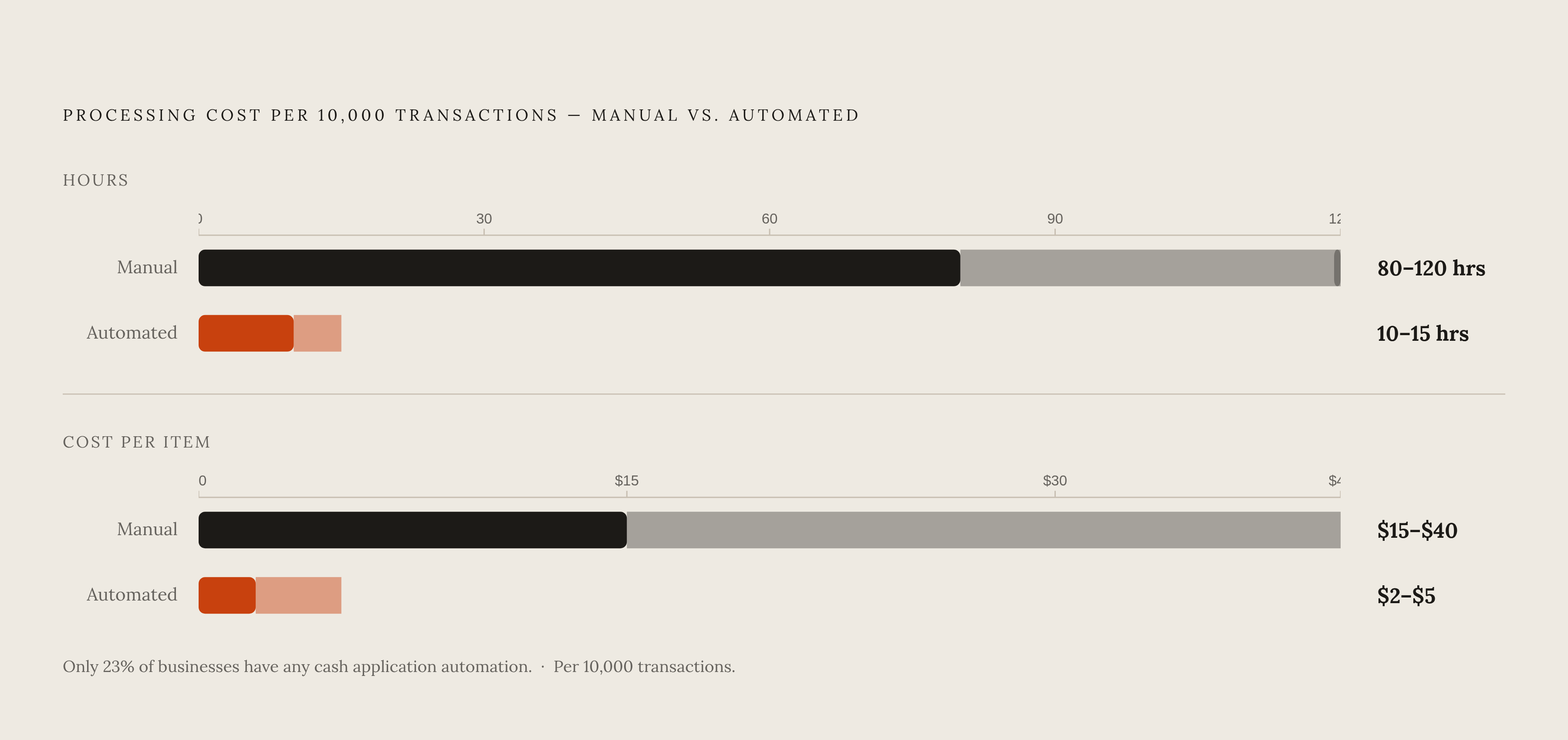
Clean matches clear themselves in seconds, and nobody spends hours on the invoice that matched perfectly on the first pass. All the manual hours pile up on the exceptions, and deductions are the longest, gnarliest exceptions in the pile. Processing an invoice or payment task by hand runs $15 to $40 per item, versus roughly $2 to $5 with automation. Across 10,000 transactions, that gap is 80 to 120 manual hours compared to 10 to 15 automated hours, and deductions are among the primary contributors to that gap, given how much manual investigation each one demands.
Not every deduction deserves the same treatment, either. A known early-payment discount that matches pre-agreed contract terms should auto-approve without a human touching it. A deduction with no clear justification needs a person looking at it. Building one workflow for both is like sorting mail by throwing everything into one bin: technically a system, just not a useful one. Teams that skip this split end up burning the same review time on a five-dollar rounding difference as they do on a five-thousand-dollar dispute, which is exactly backwards.
Unapplied cash: the silent drag on DSO and working capital
Unapplied cash is money that came in but can't get matched to an open invoice, usually because the remittance data behind it is missing or too tangled to sort out. That cash just sits there. It can't get reinvested, can't get counted properly, and it quietly inflates DSO while making customers look riskier than they actually are, since their "open" balance is really just a paperwork problem.
The scale of this nationally is startling. A 2025 Working Capital Survey found roughly $1.7 trillion in excess working capital trapped across the largest public companies, with accounts receivable the single biggest chunk of it, and aggregate DSO getting worse for a second year running.
The pattern holds at the team level, too. BlackLine's B2B AR benchmarking data shows companies still running manual AR processes carry DSO that runs 30% longer on average than companies using automation. Only 23% of businesses have any cash application automation running at all, and 52% of finance leaders point to too many manual processes as the single biggest weakness in their AR function. That gap, between how big the problem is and how few companies have actually fixed it, is the real story here.
Unapplied cash doesn't just mess with DSO. It eats into customer credit limits with invoices that are technically already paid. Collections teams end up calling customers about balances that don't exist anymore, an awkward call for everyone on the line. Cash flow forecasts drift from reality because the numbers feeding them are wrong at the source, and at high invoice volumes, even a small percentage of unapplied cash turns into a genuinely large dollar figure sitting idle.
Supplier portal friction as a structural bottleneck in enterprise reconciliation
Big buyers love routing suppliers through procurement portals like Coupa and Ariba. Separate logins, specific invoice formats, document uploads, buyer-defined workflows, all before the invoice even lands in the buyer's AP queue. Great for the buyer's control. Rough for whoever's on the other end trying to get paid.
Portal friction breaks reconciliation in specific, repeatable ways. An invoice submitted with a formatting error gets rejected and bounced back, resetting the aging clock as if it were never sent. Payment status only lives inside the portal, so someone has to log in just to check. Remittance detail sits behind that same login wall. Every one of those steps adds delay and demands a person babysitting it.
Research on mid-market finance teams consistently shows a large majority still rely on manual reconciliation for international transactions, with teams spending significant hours each week chasing unmatched payments, fixing discrepancies, and reconciling across disconnected systems. Portal management eats a big piece of that time on its own.
The nastiest part is the cascading effect. A portal rejection nobody notices doesn't just delay payment, it delays reconciliation too, since the invoice never formally reaches a matched state anywhere. It floats invisible until someone stumbles onto it during month-end close and has to figure out why it's been sitting there for three weeks.
Portal friction isn't a problem one more software integration solves. It takes real, ongoing attention: someone watching submission status, tracking rejection reasons, managing resubmissions by hand. Once every failure point above is on the table, the next question answers itself: fix the sequence in the order things actually happen.
A structured reconciliation workflow for high-volume AR: the step-by-step process
Treat this as three distinct phases, not one blob called "reconciliation." Data quality gets handled at ingestion, matching logic runs in the middle, exception resolution happens at the end. Mixing these up is how teams end up patching symptoms instead of causes.
Phase 1 is data ingestion and normalization. Every incoming payment, regardless of rail (ACH, wire, check, portal), needs to land in one working dataset before any matching starts. Reference fields need standardizing: enforce invoice number formats in customer payment instructions up front, and flag anything missing structured remittance the moment it arrives, not weeks later when someone's trying to match it. IOFM's 2025 data shows 41% of finance teams using AI reconciliation name data consolidation as their biggest implementation hurdle, confirming this is where most rollouts stumble before matching even enters the picture. Some remittance data will always arrive fragmented, by email, by fax, buried in a portal, and the workflow needs a collection step that gathers all of it before the match run kicks off.
Phase 2 is automated matching by method. Apply two-way matching to services, subscriptions, and pre-approved recurring charges, no goods receipt needed, so this runs fully hands-off. Apply three-way matching to physical goods, checking invoice, PO, and goods receipt against quantities, unit prices, and totals before auto-approval. Set tolerance thresholds for minor variances, rounding, small shipping discrepancies, so those clear automatically instead of clogging an exception queue. Leading platforms report automated match rates of 90% to 95%. Treat that range as a target to design toward on day one.
Phase 3 is exception triage and resolution. Group exceptions by type the moment they land: remittance gaps needing more data, amount variances needing deduction research, timing issues where payment posted late, fraud flags needing immediate escalation. A remittance gap and a fraud flag have nothing in common, so each exception type should route to whoever actually owns that kind of problem. They shouldn't hit the same desk. Set resolution SLAs by exception type: remittance gaps closed within a business day, deduction disputes within a defined window, anything unresolved past a set threshold escalates automatically instead of quietly aging. AFP's Payments Survey put the fully loaded cost of manually reconciling a single transaction at $8 to $12, and the real business case sits in cutting how many exceptions get created in the first place, not in resolving them faster once they already exist.
Phase 4 is posting and close. Matched transactions post straight to the general ledger, while exceptions get staged separately until someone clears them. Available data shows AI reconciliation cuts unmatched items at period-end by 74%, with meaningful reductions in period-end adjusting entries as well. Fewer loose ends at close means a faster close, plain and simple: Finance teams running AI reconciliation consistently report closing their books faster per period.
Data quality as the foundation: why process improvements fail without clean inputs
None of the above works without clean data feeding it. Matching logic, tolerance rules, exception routing, all of it depends on incoming data being reliable. A small formatting mismatch or a missing field creates a false exception that eats the exact same amount of manual time as a real one. The system can't tell "genuinely wrong" from "typed slightly differently," and that's the whole problem in one sentence.
A few specific sources cause most of the damage. ACH transactions with truncated or nonstandard reference fields force matching off amount and date alone. Remittance data gets lost moving from a modern-looking front-end banking interface into a decades-old back-end core. Customer reference numbers don't line up with the seller's own invoice numbering scheme. The same company appears under three different names across invoices, POs, and payment records: legal name here, trading name there, an abbreviation somewhere else.
Fixing this isn't glamorous. Clean up master data for customers and vendors. Set invoice numbering standards and communicate them to customers at onboarding; do this before the first invoice ever goes out. Bake remittance format requirements into portal setup instead of hoping customers figure it out on their own, and audit reference field population rates by payment rail on a regular schedule, because these things drift without anyone touching them.
Cross-border reconciliation adds its own tax on top of all this. FX leakage from uncaught rate discrepancies can be material, and unclaimed intermediary fee deductions can add up to thousands of dollars a year. Both are direct consequences of bad data in the reconciliation layer, not separate FX management failures sitting off to the side.
Data quality is closer to brushing teeth than renovating a kitchen: an ongoing discipline, not a one-time fix. Treating it as a project with an end date lets exception rates creep right back up within a single reporting cycle.
How automation and AI change the reconciliation capacity equation
Which pieces of the workflow automate cleanly and which still need a human brain attached varies by exception type. The taxonomy from earlier answers this pretty directly: remittance-gap and timing exceptions are largely mechanical and automate well, while deduction disputes and fraud flags still need judgment calls only a person can make.
AI-native reconciliation tools pull transaction records in from every source, normalize the formats, run matching logic against open AR, apply tolerance rules the system has learned over time, sort exceptions by type, and route them to the right queue. No human exporting a spreadsheet at 11pm to hit a month-end deadline.
Manual effort per 10,000 transactions runs 80 to 120 hours, versus 10 to 15 hours with automation in place. That gap isn't a faster version of the old process, it's a different process entirely: one where the team spends its hours on the deduction dispute that actually needs a human, instead of chasing down a reference number a machine could have matched on the spot.