Invoice Delivery Methods and Open Rates in B2B
Choosing the right invoice delivery channel determines whether buyers even see it.

The channel an invoice leaves on decides most of its fate before anyone reads a single line item. Paper, email, portal, EDI, or a network like Peppol: each one starts a different clock, with a different shot at getting paid on time. Get the channel wrong and the invoice may never even hit the queue. AP departments have gotten pickier about this too. Some now reject anything that shows up outside their preferred lane, no matter how clean the numbers are.
That's the real difference between B2B and consumer invoicing. A B2C receipt just needs a working email address. A B2B invoice has to survive multi-person approval chains, ERP matching rules, and whatever format a customer's AP team locked in three system migrations ago. Delivery is infrastructure here, not a formality tacked onto the end of billing. Get it wrong, and a payment stalls, not just an inbox.
Three things ride on the delivery choice: does the invoice get seen, can the buyer's system process it without a human retyping it, and how fast does it clear approval. Every channel answers those three questions differently. Most finance teams have never sat down and compared the answers side by side.
The scale of the shift already underway in B2B invoice delivery
Roughly 280 billion B2B, B2G, and G2B invoices went out globally in 2024. Only about a third, somewhere around 90 billion, were genuinely electronic. Two-thirds of the world's invoice volume is still stuck somewhere between paper and a PDF that no system can read on its own.
Digital delivery keeps gaining share, and it picked up further in 2025. So the direction is clear. It's just slower than the pitch decks suggest, and the long tail of paper and loose PDFs isn't clearing out on anyone's marketing timeline.
More than 80 countries now enforce some form of e-invoicing mandate, and that count keeps climbing. It's squeezing the runway for anyone still routing invoices through the mail room. None of this is a stable backdrop, either: mandates shift, big buyers change onboarding rules mid-year, and networks add members constantly. A channel that works fine for a supplier today can quietly go non-compliant eighteen months out, with no memo attached.
Paper mail: usage and cost for those who still rely on it
Paper hasn't vanished, and pretending otherwise gets the diagnosis wrong. It survives in legacy customer relationships, certain regulated industries, and administrative setups where somebody still expects an envelope. Small businesses lean on it hardest: Visa-sourced data cited in industry reporting puts the share of SMBs still running paper invoices and manual AP work as high as 70%, though that number is a general signal for the segment, not a precise current count.
Here's what paper costs, mechanically, not philosophically. Delivery lag runs days to weeks before the invoice even lands on a desk. There's no read receipt, no delivery confirmation, no way to know it arrived at all. Printing and postage get baked into every send regardless of invoice size. And manual AP processing, which paper pushes toward its most expensive form, ran $18 to $26 per invoice in 2025, up from $16 to $23 the year before, with average processing time at 14.6 days.
Paper earns its place in a few cases: some regulated industries require a physical document by law, and some counterparties genuinely lack any electronic receiving setup. But defaulting to paper out of habit, rather than requirement, buys zero visibility into payment status and a processing cost that climbs before the money reaches the account. That deserves sustained attention.
Email with PDF attachment: the dominant channel and its hidden friction
Email is the default, and it works fine for buyers without a portal or EDI connection. The catch sits in the attachment itself. A PDF is built for human eyes, not machines, so a buyer's AP system can't ingest it without OCR or someone typing the numbers in by hand. That makes email-plus-PDF a step up from paper, but calling it a real eInvoice is generous. Failed sends can sit invisible in an inbox for weeks with nobody the wiser.
Three separate failure modes live inside this one channel, and each needs its own fix. A deliverability failure means the email bounces, hits a spam filter, or lands with a contact who left the company two years ago, with no confirmation it ever arrived anywhere. An open failure means it lands fine and just sits there, unread. A processing failure means it gets opened, then someone has to manually key the PDF into the ERP, which drags back the exact rekeying error rate paper never solved.
Open rates tell a genuinely different story here than most people assume, mostly because invoice emails don't behave like marketing emails. General B2B marketing open rates run somewhere in the mid-thirties to low forties percentile range. Transactional email, the category invoices fall into, tends to outperform general marketing email, though precise benchmarks vary by study and segment. Emails linking out to invoices or payments tend to draw strong click-through rates, because the recipient is acting on something they were already expecting and actually need to close out.
One wrinkle before anyone gets excited about those numbers: Apple's Mail Privacy Protection pre-loads tracking pixels whether or not a human ever opens the email. As of early 2025, that quirk accounts for roughly half of all tracked opens industry-wide, inflating reported open rates by something like 18 points in datasets that don't filter for it. A chunk of those "opens" never happened.
The bigger failure sits downstream of opens anyway. A substantial share of manually processed invoices contain errors, and PDF-via-email is a major driver of that, since it forces rekeying at the buyer's end on every single send. Delivery tracking and bounce detection on the sending side close some of the visibility gap, but none of that touches what happens once the PDF lands on someone's desk and gets typed in by hand.
Email earns its keep for buyers with no portal, no EDI, and lower invoice volumes, where a familiar format actually reduces friction instead of adding to it.
AP portal delivery: highest buyer control, highest supplier friction
Big buyers increasingly want invoices uploaded straight into their own AP portals, systems from vendors like Coupa or Ariba, and a growing number won't process anything submitted any other way. From the buyer's seat that logic holds up: a portal lets AP control format validation, PO matching, and approval routing before any payment obligation exists.
From the supplier's seat, it is a grind that scales badly. One industry platform documents more than 260 distinct AP portal integrations in the wild, so a mid-sized supplier selling into a diverse customer base juggles a different login, a different format, and a different submission process for every major account. Call that a delivery channel if you want. It functions like a part-time job.
The friction occurs in the same few spots every time. Compliance overhead runs high, since a wrong format, a missing PO reference, or a missing document like a W-9 kicks the invoice straight back into the queue. The open-rate concept barely translates either: an invoice counts as "received" the moment it's uploaded, but whether anyone's actually looking at it depends on portal-specific reporting, nothing close to an email read receipt. And portal-specific blockers, an unresolved vendor flag or a compliance hold, can leave an invoice sitting in limbo without any signal reaching the supplier at all.
Portal delivery punishes anyone who treats it as set-and-forget. It needs someone watching submissions, catching rejections, and resubmitting on a schedule email never demands.
EDI: reliable at scale, costly to set up, and showing its age
EDI predates most of today's e-invoicing mandates by decades. Large manufacturers, retailers, and logistics companies have swapped structured documents (purchase orders, shipping notices, invoices) over it for years, long before "eInvoicing" became a regulatory buzzword. It runs over dedicated point-to-point connections or value-added networks, using formats like EDIFACT, and the data flows straight into ERP systems on both ends without a human touching it.
The setup is where it earns its reputation for being a pain. Every trading partner connection needs its own coordination, its own format agreement, its own testing cycle. Fine for a handful of big, stable relationships. A nightmare for a long tail of smaller buyers, since any change to document structure forces both sides to agree and rebuild, the whole system being rigid by design. Below a certain transaction volume, the ongoing cost simply doesn't pencil out, and pretending otherwise wastes money.
Once it's running, though, EDI delivers real gains: no keying errors, faster PO matching, shorter approval cycles, the same benefits any structured format offers, wrapped in older, proprietary plumbing. And that plumbing keeps adapting instead of dying off. Providers have been adapting their offerings to accommodate newer structured formats alongside traditional EDI flows, letting legacy setups keep pace with new compliance rules rather than getting replaced outright.
EDI still makes sense for established, high-volume relationships where setup cost spreads across thousands of transactions. It's the wrong tool for onboarding a new buyer or handling occasional orders, full stop.
Peppol and structured eInvoice networks: the emerging default for cross-border and regulated flows
Peppol runs on a four-corner model. Any sender can reach any receiver through certified Access Points, with no bilateral setup and no custom integration per partner. That single design choice is what let the network scale the way it has: 46 countries and territories now belong to OpenPeppol, with 1.4 million organizations registered and over 300 certified Access Points as of late 2025.
Peppol already dominates B2G invoicing and keeps picking up B2B share across Europe, Australia, New Zealand, Singapore, and the UAE. The compliance landscape it produces is not uniform, though, and treating it as one system is a mistake. Three models exist worldwide: clearance, where a government portal validates the invoice before it ever reaches the buyer (Italy, Brazil, Mexico, India); post-audit, historically the norm across much of Europe; and network models, which countries including Belgium, France, and Germany are actively rolling toward.
Germany makes a clean case study. Under the Growth Opportunities Act, businesses have had to be able to receive EN-compliant eInvoices since the start of 2025. Issuing them becomes mandatory for large businesses in 2027, then for everyone in 2028. Accepted formats include XRechnung, Germany's primary national CIUS format, and Peppol's own BIS Billing standard.
Structured invoices clear validation faster than a PDF ever could, often landing and processing in under a day. Industry data points to roughly 73% faster processing and 85% fewer disputes compared with paper, with days sales outstanding dropping 6 to 10 days. Once an invoice moves through Peppol or EDI, "open rate" stops meaning anything. Nobody's opening an email. What matters instead is validation pass rate and time-to-approval, full stop.
What the cost gap between channels reveals about where invoices quietly fail
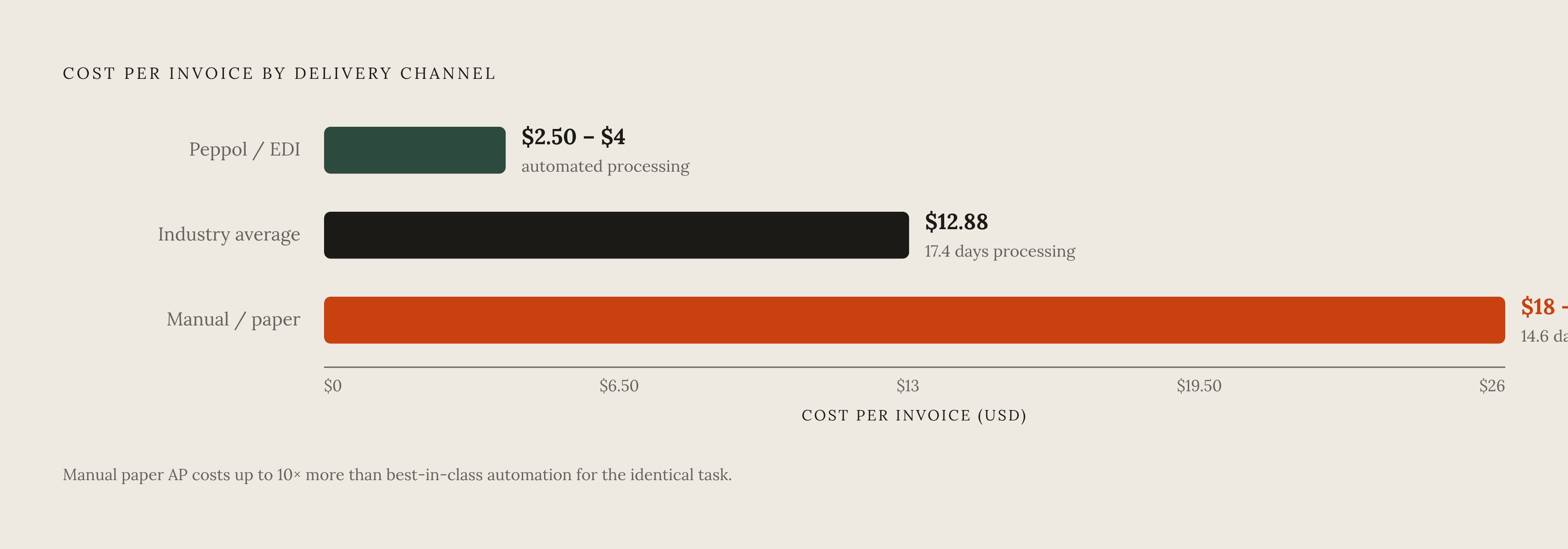
Line up the cost numbers and the story tells itself. Best-in-class automated invoice processing runs $2.50 to $4 per invoice. Manual, paper-heavy AP runs $18 to $26. That gap isn't a rounding error, it's several hundred percent on the same task.
Industry benchmarking puts companies without that level of automation somewhere in the middle, averaging around $12.88 per invoice and 17.4 days processing time. Even now, only about a third of invoices move end-to-end with minimal human involvement. More than two-thirds of respondents in one survey said they still manually key invoices into their ERP or accounting software.
If the buyer's AP team is retyping a PDF by hand, that invoice sits in the same slow pile as every other manually keyed invoice from every other supplier, regardless of who sent it or how correct the numbers were. Processing time stretches, error rates climb, payment timing slips. None of that traces back to the buyer's internal discipline so much as whether the delivery channel dropped the invoice into an automated workflow or the manual pile. The manual pile is where invoices sit around aging like bad cheese, and nobody's checking the expiration date.
How to read your channel mix against these friction and open-rate profiles
No single channel wins across every buyer relationship. The real skill is knowing which channel each specific buyer actually requires, and running all of them from one coordinated setup instead of managing five disconnected habits stitched together over time.
A few honest questions, channel by channel, need asking on a recurring basis, not just once. For email and PDF: is anyone tracking bounces separately from Apple's inflated open numbers, and does anyone actually know how many of those PDFs get rekeyed by hand on the other end? For AP portals: is there a clear list of which customers require portal submission, and is anyone tracking why invoices bounce back, missing documents, format errors, vendor setup issues? For EDI: does the transaction volume with that specific partner justify the setup cost, and are the specs still current? For Peppol or other structured formats: does the business operate in a jurisdiction with an active or upcoming mandate (Germany's 2027 and 2028 deadlines being the obvious marker), and does the output format actually match what the buyer's system can receive?
Channel analysis alone won't catch everything. A perfectly formatted, correctly delivered invoice can still stall on a missing W-9, an unresolved portal credential, or a question from the buyer's AP team that nobody answered in time. Those gaps sit between delivery and payment, and no amount of channel optimization fixes them by itself.
Days sales outstanding is the cleanest single number to track across all of this. Structured eInvoicing already shows a 6 to 10 day DSO improvement over paper. Breaking DSO out by delivery channel, instead of treating it as one blended average, gives finance teams a real answer to the question that actually matters: which channel is quietly costing the most days, and which one's earning its keep.
