Resolving Purchase Order Mismatch Disputes With Enterprise Customers
Unresolved mismatches delay payment, drain working capital, and end customer relationships.

Purchase order mismatches don't announce themselves as disputes. They show up quietly, as a missing field or an unreconciled price change, and by the time anyone notices, the invoice has been sitting in a queue for weeks. Per PYMNTS 2025 research, 40% of B2B payment delays come from disputes, not from customers lacking the money. The buyer can pay. The invoice just won't clear their system.
Atradius put out a 2025 study with numbers that should make any finance leader wince: 43% of B2B invoices in the US are currently overdue, only 52% get paid on time, and 5% get written off as bad debt entirely. Separately, Atradius research found the average company loses close to $40,000 a year to late payments and the disputes trailing behind them. And 26% of business decision-makers say they've cut ties with a buyer or supplier outright over payment delays. Read that again. Disputes aren't just clogging up AR. They're ending relationships.
Enterprise customers make this worse by design, not by accident. Layered AP systems, procurement portals, departmental sign-offs, three different people who all need to say "looks good" before a payment fires. One missing field can restart the whole clock. The good news: these mismatches follow patterns. They're boring, predictable, and fixable, once someone treats them like a process problem instead of a one-off fire to put out.
The three documents that must agree before an enterprise customer will pay
Enterprise AP teams don't just eyeball an invoice and nod. They check it against three sources of truth: the purchase order (what was agreed and priced), the contract (negotiated terms and payment conditions), and the goods receipt note, or GRN (what actually showed up and got signed for). This is called three-way matching, and payment only releases when all three line up. Think of it as a jury needing a unanimous verdict. One holdout, and nothing moves.
Some industries add a fourth document, a formal inspection or acceptance record, mostly in regulated sectors where quality certification isn't optional. Three-way matching is good at catching price deviations. Four-way matching is better at catching quantity problems, since someone's physically confirming what landed versus what was promised.
Enterprises also build in tolerance thresholds, usually plus or minus 1% or 2%, to avoid drowning in disputes over fuel surcharges or currency rounding. One logistics company set a ±1% tolerance and prevented more than 800 trivial disputes a year, while still catching the real discrepancies. That's not a rounding error, that's an entire department's worth of email saved.
For suppliers, knowing how a customer's AP system is configured tells you which mismatches auto-reject and which quietly route to a human for manual review. That distinction tells you what to fix first.
There's also a fraud angle worth sitting with. Three-way matching isn't just an accounting nicety, it's a control against fake invoices. The FBI's IC3 reported 21,832 business email compromise complaints in 2022, with adjusted losses over $2.7 billion. Invoices that bypass matching controls are a known way in, even at large, sophisticated enterprises.
The five mismatch types that account for most enterprise disputes
Industry research suggests approximately 39% of invoices carry some kind of error, and manual processing alone accounts for over 30% of PO discrepancies. Knowing which type of mismatch you're dealing with tells you who to call, what paperwork to pull, and how fast the thing can actually get fixed.
A pricing discrepancy means the invoiced price doesn't match the PO or the contract. Usually because someone's working off an outdated price list, forgot to apply an agreed discount, or copied a number from the wrong sheet. Especially common when a price got changed on a phone call and nobody ever updated the system. Verbal agreements are lovely. They're also invisible to software.
A quantity mismatch means the invoice bills for more than what arrived. The classic version: PO for 1,000 units, 600 show up first, the warehouse doesn't log the partial delivery while waiting on the rest, and an invoice for the full 1,000 sails through anyway. Partial shipments billed as complete are one of the most common ways this happens.
A missing or incorrect PO number means the link between invoice and order is either absent or wrong. Without a valid PO number, enterprise AP systems can't auto-match anything, so the invoice sits in a manual review queue, or gets rejected outright. Ironically, this is one of the fastest disputes to fix once someone spots it, and one of the most common causes of delay that nobody can explain.
Tax and discount errors cover a wrong sales tax rate, or an agreed rebate that never made it onto the invoice. Buyers who've already pre-confirmed the expected amount in their own system find this particularly annoying, and fairly so.
With hidden line-item offsets, the total looks fine. But dig into the line items and one's billed high while another's billed low, canceling each other out on paper. No variance is innocent until someone checks its origin, because matching totals can hide systematic overcharges that build up quietly over time, invoice after invoice, until the number gets big enough to notice.
A deduction is a separate matter from a mismatch. That's when a customer just reduces payment without asking first, citing some reason on their end. It skips the formal dispute process entirely and needs a different response than a flagged line-item error.
Where these mismatches actually originate inside enterprise procurement workflows
Most invoice errors don't start in accounts payable. They start earlier, before the invoice even exists, back in procurement.
PO data drifts from reality constantly. A price changes on a call, a delivery date shifts in an email thread, and none of it gets updated in the system that AP will later use for matching. Different departments inside the same enterprise often run their own procurement processes too, creating POs with different formats, missing fields, incomplete data. Chaos in AP frequently starts at the moment the order was created, not when the invoice lands.
Manual entry doesn't help. The IOFM has measured a 3.6% data-entry error rate in departments still working off spreadsheets and manual matching. And on the receiving end, warehouse staff often hold off logging a partial delivery because they're expecting the rest of the shipment any day now. That gap sits open, waiting for a mismatch dispute to fill it.
Here's the blind spot suppliers rarely see coming: if a buyer amends a PO and doesn't say so explicitly, the supplier has no way of knowing. The invoice is entirely correct according to the seller's own records. It's just wrong against a version of the PO the seller never saw. Fixing the invoice without tracing the mismatch back to where it started just guarantees the same fight happens again next billing cycle.
What a disputed invoice costs in DSO and working capital while it sits unresolved
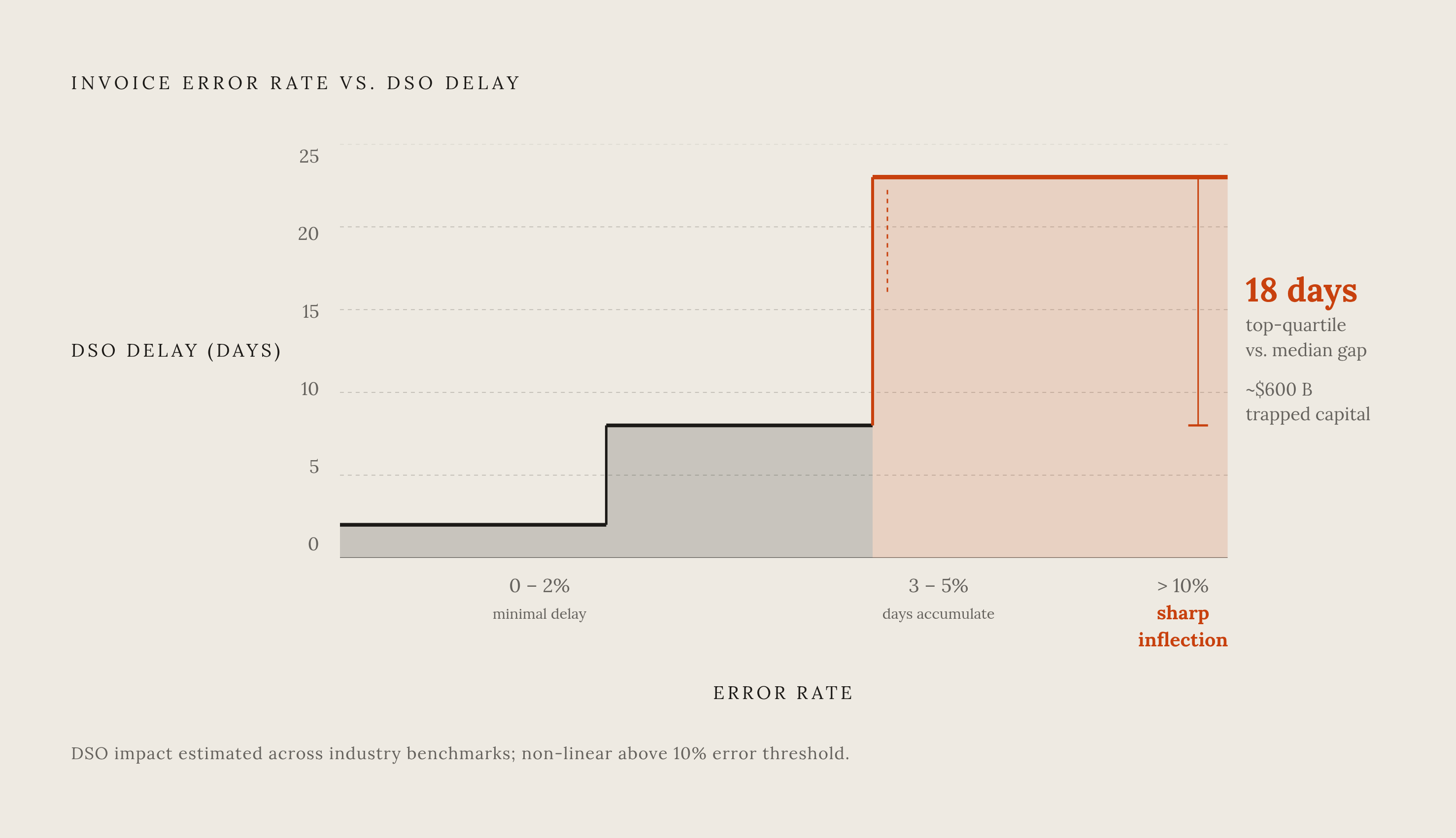
Every dispute restarts the clock. That's the quiet cost nobody puts on a slide deck. A disputed invoice stalls the order-to-cash cycle right at collections and inflates Days Sales Outstanding directly, no delay, no lag.
The relationship between error rate and delay isn't linear, either. A 0 to 2% invoice error rate barely dents anything. Push that to 3 to 5%, and days start stacking up per disputed invoice. Go above 10%, and the delay gets substantially worse, not proportionally, but sharply.
The Hackett Group's 2025 survey of a national market found an 18-day DSO gap between top-quartile and median performers among the largest 1,000 public nonfinancial companies in that market. Working Capital Survey found an 18-day DSO gap between top-quartile and median performers among the largest 1,000 US public nonfinancial companies. That gap represents something like $600 billion in trapped working capital. Not "tied up." Trapped, sitting there, doing nothing for anyone.
Industries with elevated invoice-to-PO mismatch rates, including manufacturing and freight, tend to accumulate disputes that age past 60, 90, and 120 days. And once a dispute crosses the 90-day mark, it's three times less likely to ever get recovered. The window for a clean resolution closes fast, and it doesn't reopen.
Roughly 60% of disputes could get resolved with better documentation at the first point of contact. Meaning most of that aging AR isn't some intractable disagreement between two companies who see the world differently. It's a paperwork failure wearing a business-dispute costume.
Atradius also found that 1 in 10 firms loses more than $100,000 a year to unpaid invoices and the disputes tangled up with them. And the cost isn't only financial. Resolving a dispute usually drags in sales, operations, project management, and sometimes legal, just to sort out who said what to whom. Even when the invoice turns out to be correct all along, the cost to serve that customer has already gone up.
A step-by-step process for diagnosing and resolving each type of PO mismatch
Step 1: Acknowledge within 24 to 48 hours. Even a short note confirming receipt and setting an investigation timeline. Flag the invoice internally as "in dispute," and pause any automated late-fee or collections process right away. Give the buyer a named contact, not a shared inbox. Enterprise AP teams move faster when there's an actual person to talk to.
Step 2 is to categorize before investigating: is it pricing, quantity, a missing PO number, a tax error, or a deduction? This determines who owns the investigation. AR owns the invoice, sure, but sales knows what got negotiated, operations knows what shipped, and legal knows what the contract actually says. Hand it to the wrong team and watch the clock burn for no reason.
Step 3 is to pull the full documentation set: original PO, contract with any amendments, delivery records or GRN, and every prior message about the order. Line up what was agreed, what was delivered, and what got invoiced, side by side. The dispute lives in the gap between those three. Check specifically for verbal changes nobody wrote down, since that's usually where the root cause is hiding.
Step 4: Open with questions, not accusations. Reach out to the buyer's AP team and ask what their system shows, not what's wrong with theirs. Something like "here's what's on our end, what are you seeing on yours?" lands far better than leading with a correction. Nobody likes being told they're wrong before they've even opened the email. For a missing PO number specifically, just send the correct one with a clear reference. That alone often closes the loop the same day.
Step 5 is to resolve by mismatch type.
- Quantity: get delivery confirmation (GRN, proof of delivery, warehouse log). If a partial shipment caused it, split the invoice, one for what arrived, one for the remainder once it ships.
- Missing or wrong PO number: get the right number from procurement or AP, resubmit with the correct reference, and confirm it clears the matching queue.
- Tax or discount errors: pull the contract clause or discount schedule, correct the invoice, and note the right rate for every future invoice on that account so this doesn't repeat.
- Hidden line-item offsets: reconcile line by line, never just the total. Document each variance and where it came from before touching a correction.
Step 6: Set escalation thresholds before disputes age. Decide in advance what dollar value or age automatically kicks a dispute up to a finance director or senior account owner. One manufacturing enterprise set autoescalation above $50,000 straight to the finance director's desk, and cut high-risk backlog cases by 70%. Without a rule like that, a substantial dispute sits in the same queue as a trivial rounding error, waiting its turn.
Step 7 is to confirm resolution in writing: get written confirmation that the corrected invoice was received and approved for payment. Note the resolution on the account record, since that becomes the paper trail if the same dispute resurfaces or a legal question comes up later. And capture any revised payment date the buyer committed to, in writing, not in a hallway conversation nobody remembers the same way.
How enterprise supplier portals change the resolution workflow
Big enterprise buyers running platforms like Coupa or Ariba require invoices submitted inside their portal, though some configurations also support email, PDF, cXML, or EDI depending on how they're set up, but sending a corrected PDF by email when the buyer wants portal submission doesn't move anything forward. It just sits there looking helpful while doing nothing.
Portals create their own specific friction. An invoice might get rejected because the PO number is invalid or expired, which means going back to procurement for a fresh one before resubmitting. Correction invoices have to match the portal's format exactly, so emailing AP a fixed PDF doesn't update the matching queue on their end. Missing onboarding paperwork, a W-9, banking details, vendor registration, can hold an invoice in "pending" indefinitely, and that's a completely different blocker that just happens to look like a dispute from the outside.
Status labels add another layer of confusion. "Under review," "in dispute," "on hold," "pending approval," these all mean different things and call for different follow-up. Treating them as interchangeable wastes time chasing the wrong fix.
The better approach: check the specific status and rejection reason inside the portal first, rather than guessing. Contact the buyer's portal administrator directly for portal-specific issues, not the general AP inbox that may not even have visibility into it. And track submission timestamps carefully, since payment terms often get calculated from the moment something hit the portal, not the moment it was emailed. Teams that treat the portal as its own system, with its own rules, close disputes faster than teams that treat it as an afterthought to email.
When a PO mismatch dispute needs legal or contractual escalation
Most PO disputes get resolved operationally, through documentation, a phone call, and a corrected invoice. Legal escalation is the exception, not the routine move, but knowing where the contractual line sits matters even when it never gets crossed.
Escalation becomes worth considering when a dispute involves a genuine disagreement over contract terms rather than a documentation error, when the dollar amount is large enough that a written resolution needs to be enforceable, or when a pattern of repeated mismatches with the same customer suggests a structural problem rather than a one-off mistake. A single pricing error is an operations fix. The same pricing error recurring across six invoices in a row belongs in front of legal, since a pattern like that needs a contractual answer, not another credit memo.