SAP Business Network Invoice Compliance Rules
Governments are forcing e-invoicing compliance across dozens of countries using SAP's network.

Electronic invoicing used to be a nice-to-have, the kind of upgrade an IT team pitched at budget season alongside a new expense app. That window has closed. Across dozens of countries, e-invoicing has turned into law, and SAP Business Network has become the place where that law actually gets enforced, invoice by invoice, at the moment a supplier hits submit.
The motive is money, and it's not subtle. Governments are using structured digital invoice exchange to close the VAT gap, catch fraud earlier, and force tax reporting to happen in something closer to real time. Nobody is doing this to make procurement teams' lives easier. It's a tax collection strategy wearing a compliance costume.
The scale of it demands attention. More than 85 countries now have some form of e-invoicing or real-time reporting obligation on the books, with PwC flagging 2026 through 2030 as the "critical implementation window" for everything still coming down the pipe. This isn't a distant policy conversation. Belgium, Brazil, and Poland already flipped the switch in 2026. France follows in September of the same year, and the United Arab Emirates opens a voluntary pilot that July before its first mandatory deadline lands in January 2027.
Europe's version of this is arguably the biggest single undertaking: the EU's VAT in the Digital Age package, known as ViDA, got adopted by the Council of the EU on March 11, 2025. Its rollout stretches from April 2025 all the way to January 2035, with cross-border e-invoicing obligations kicking in during July 2030 and full alignment of domestic reporting systems targeted for January 2035. That's a ten-year runway for something that France requires invoices to be kept for, under archiving obligations that vary by jurisdiction and are enforceable.
None of it looks the same from country to country, either. Some governments want invoices cleared: a tax authority signs off before the document is even legally valid. Others just want a report filed after the fact. Some run a hybrid of both, and every jurisdiction has its own schema, its own file format, its own submission channel, and its own rules about how long you have to keep records around. So the mandate is a patchwork of many mandates. It's dozens of slightly different ones, all landing on business networks at roughly the same time.
SAP Business Network's two-layer architecture separating supplier validation from regulatory reporting
Think of it like a restaurant kitchen: one station handles the actual cooking (getting the invoice right, checking it against house rules), and a separate station handles plating it exactly the way each specific customer ordered it. Different jobs, different stations, one meal that still comes out the door correctly.
The first layer, SAP Business Network, is the supplier-facing side of the operation. It's where invoices get created, checked against whatever rules the buyer has set up, and routed onward, all before the invoice ever touches an actual enterprise system. The second layer, SAP Document and Reporting Compliance, picks up from there. It acts as the eDocument and statutory reporting engine, converting invoice data into whatever schema a given country demands, handling submission to the right government platform, and keeping an audit trail in case anyone ever asks questions later.
The clever part is where that second layer lives. SAP Document and Reporting Compliance's cloud edition runs on SAP Business Technology Platform. Regulatory updates can roll out independently of the core ERP release schedule. That matters more than it sounds like it should. Countries change their invoicing rules on their own timeline, not on SAP's, so decoupling the regulatory engine from the ERP upgrade cycle means a rule change in, say, Poland doesn't require waiting on the next big ERP patch.
Enterprise systems stay the system of record through all of this. They don't need to know or care about country-specific schema transformation and government submission, because that logic lives externally, in SAP Business Network and SAP Document and Reporting Compliance. SAP Business Network covers e-invoice localization across dozens of countries, and SAP Document and Reporting Compliance supports hundreds of report types and scenarios across more than 55 countries. That covers a narrower set than "every country everywhere." It's a growing footprint, expanding as demand and regulation catch up with each other. The integration between SAP Business Network and SAP Document and Reporting Compliance is currently available for Peppol countries (Germany, Australia, New Zealand, Belgium, Norway, Japan, Singapore, and the Netherlands), as well as Romania and Poland, per the SAP asset detail page.
How buyer-configured invoice rules govern supplier encounters
SAP doesn't set the invoice rules. Buyers do. Each buyer decides what its suppliers must submit, and those decisions can shift depending on which supplier is submitting, which country the invoice originates from, and what type of invoice it is.
Buyers configure all of this in one specific spot: the Invoice Rules section of the Default Transaction Rules page, tucked under Manage Profile in their SAP Business Network account. Suppliers, for their part, aren't left guessing. They can pull up the rules that apply to them specifically under Customer Relationships, then Customer Details, in their own account.
What do these rules actually control? Fields, mostly, and the logic gets fairly granular. A field might be always required, conditionally required depending on the transaction, optional but rule-driven, or just always optional.
VAT rules get their own layer of specificity. A buyer can require a customer's VAT or Tax ID outright, decide whether VAT ID fields even show up on the invoice header, and require the company's own VAT ID only for intra-EU trade, or only for domestic trade. There's also a rule that limits VAT or GST categories to a single instance at both the header and line-item level, specifically to stop duplicate tax entries from sneaking through.
Then there are the fields that exist because one country said so. A field called "Date Of Payment" exists specifically for transactions in France, nowhere else. It's a small detail, but it says a lot about how this system works: the general rule framework is broad, but individual countries poke very specific holes in it that suppliers have to notice.
Beyond VAT and country quirks, buyers set a batch of general invoice rules too. Some allow invoices for information purposes only. Some allow service-related invoices. Some require the invoice date to land on or after the purchase order date, no exceptions. Others let suppliers tack on shipping costs, special handling fees, or tax details as their own separate invoice lines rather than folding them in. None of this is exotic. It's the daily grind of getting an invoice through the door, just written into rule form instead of left to a human's judgment call.
Validation channel by channel before an invoice reaches any enterprise system
Suppliers submit invoices in a handful of different ways: through an online form, via cXML, over EDI, or by uploading a file directly. SAP Business Network checks the invoice against the buyer's configured rules first, no matter which channel it came in through. What changes by channel is how the supplier finds out something's wrong.
An online invoice fails or passes right there on screen, mid-entry. First, it gets checked against the cXML DTD for basic format and syntax, the invoice equivalent of checking whether the punctuation and grammar are even readable. Pass that, and the supplier gets a confirmation response back. Fail it, and they get an error response with the details attached. Only after clearing that syntax check does the invoice move on to the buyer's actual business rules, so a perfectly formatted cXML file can still bounce for reasons that have nothing to do with formatting.
Once an invoice clears validation, one more thing happens before a human ever sees it: if the country pairing on the invoice requires a digital signature, that signature gets applied, and only then does the invoice get downloaded into the buyer's invoicing system for review. Validate first, sign second, route to the buyer third. That order isn't an accident. It front-loads the correction work onto the supplier's side of the fence, before an ERP or accounts payable system ever has to deal with an exception. For buyers, that means fewer bad invoices landing in the inbox to begin with. For suppliers, it means the invoice that finally reaches the buyer is one that's actually going to get paid on time, instead of bouncing back three weeks later with a rejection nobody explained clearly.
Country-specific mandates translated into concrete rule and format requirements on the network
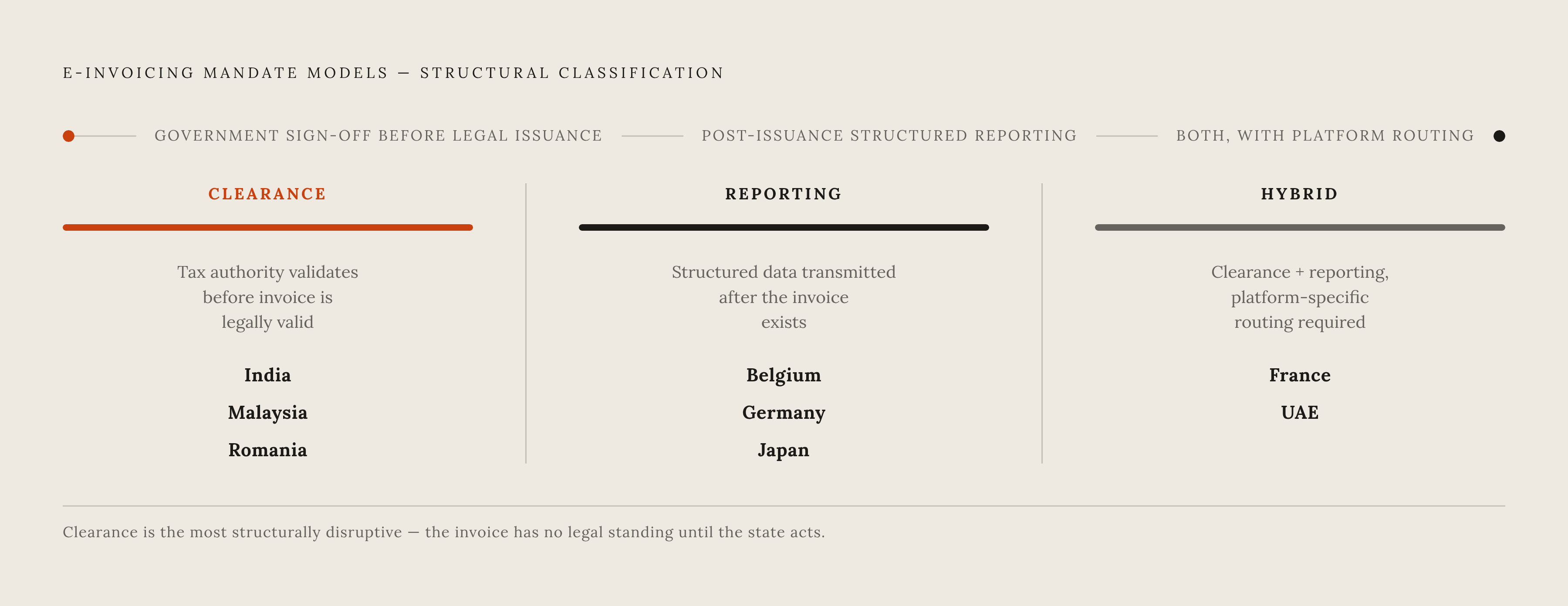
Zooming out from the field-by-field mechanics, the country-level picture gets almost comically varied. Broadly, mandates fall into three camps: clearance, where invoices are validated before legal issuance; reporting, where structured data is transmitted after the invoice already exists; and hybrid frameworks combining both. Which camp a country falls into decides what the network has to do behind the scenes.
India, Malaysia, and Romania run clearance for B2B and government-facing invoices, meaning tax authorities (ANAF, in Romania's case) have to sign off before the invoice counts as legally issued. Consumer-facing invoices in those same countries follow a lighter, after-the-fact reporting model instead. Belgium, Germany, and Japan skip clearance entirely but still demand a specific invoice format. France and the United Arab Emirates take yet another route: a specific platform or network must be engaged for compliance.
Italy is the cleanest example of a country building its own dedicated highway. Every invoice, in or out, has to move through the Sistema di Interscambio (SDI) platform, formatted as FatturaPA XML. SAP Business Network has that connectivity built in natively, no extra license required, which is about as close to plug-and-play as government mandate compliance gets.
Germany takes a looser stance on the delivery mechanism but a firm one on format. Invoices routed through SAP Business Network arrive as XRechnung (which itself supports both UBL and CII syntax underneath), while the country broadly accepts UBL, CII, or ZUGFeRD. Organizations holding a SAP Document and Reporting Compliance cloud license can even receive invoices that never touched SAP Business Network at all, arriving instead by email or Peppol.
France is the one worth watching closest, mostly because the deadline kept moving. Originally planned for July 1, 2024, France's mandate was postponed to September 1, 2026. From that date, large and medium companies have to issue e-invoices and file e-reports, while every company, regardless of size, has to be able to receive e-invoices. The accepted formats are UBL, CII, or Factur-X, all under the European Norm, and France is also introducing standardized invoice statuses so both sides can track a document's lifecycle end to end. SAP Business Network handles this by converting invoices into the mandated UBL format and connecting suppliers to the government's tax portal (PPF) as well as the buyer's accredited private platform, or PA.
Archiving requirements pile another layer of variation on top of all this. Germany wants invoices kept for eight years. France wants ten. Other countries specify a different retention period, or don't specify at all, and SAP Business Network is built to flex around whatever number a given jurisdiction requires. As of now, the direct SAP Business Network and SAP Document and Reporting Compliance integration covers the Peppol countries, plus Romania and Poland, a footprint that keeps expanding but is nowhere near universal yet. Because mandate models differ structurally across countries (clearance versus reporting versus hybrid, country-specific XML versus pan-European format versus platform-mandated routing), the compliance requirements that appear on SAP Business Network vary materially by jurisdiction, and the network's response to each is different.
The real burden the rule architecture places on suppliers operating across multiple buyers and jurisdictions
All of this sounds tidy from the buyer's side of the table. From the supplier's side, it's a different story, and to its credit, SAP's own documentation doesn't pretend otherwise. The rule architecture puts most of the weight on suppliers, who now have to juggle buyer-specific requirements on top of country-specific formats, often for the exact same invoice.
Submitting an invoice used to mean sending a document and waiting. Now it means submitting into a system that can reject you on the spot, sometimes with an error code that reads like it was written for a machine, because it was. A supplier working with ten buyers is dealing with ten rule sets, not one. They're dealing with ten, each with its own quirks, its own required fields, its own tolerance for late invoice dates. There's no single configuration to master and move on from.
SAP's own strategy documents flag a friction point that's almost funny if it weren't so costly: a supplier might receive a purchase order through one portal, then get told to send the invoice through an entirely different, government-mandated platform. That's the network equivalent of ordering a pizza through an app, then being told to drive to a separate building to pay for it. It defeats the purpose of having a unified network right when unification matters most.
A second risk is buried in here too. Continuous transaction controls, the systems built to catch fraud, occasionally flag an honest business by mistake. That's a false positive interrupting a real transaction, and VAT specialists have pointed out that centralized validation of this kind can rack up real compliance costs even when nothing fraudulent is happening. Add to that a data point from PwC: most businesses don't have a clear view of their own compliance obligations or what's coming next. So a good chunk of the companies relying on SAP Business Network's rule engine haven't fully mapped out what they're actually exposed to. The ground keeps shifting under them, not because they're careless.
None of this means the system is broken. It means suppliers need to actually understand the mechanics, rule by rule, buyer by buyer, instead of assuming compliance is something that happens automatically in the background.
Error handling assisted by automated tooling shortening resolution time when validations fail
When a validation fails, the real cost is the time spent afterward. It's the time spent afterward, staring at an error message written in XML or JSON, trying to figure out what actually went wrong. Tax accountants and finance teams navigating e-invoicing mandate complexity have lacked a fast way to decode technical errors without wading through XML or JSON format detail.
SAP's answer is integrating Joule into SAP Document and Reporting Compliance to target the bottleneck of interpreting technical error messages in XML or JSON formats, by translating structured errors into plain-language explanations. It's a small shift on paper. In practice, resolving a rejected invoice takes minutes, or it costs half a day lost to a support ticket that starts with "can someone explain what this error actually means."
That's the direction the whole compliance architecture seems to be heading: rules get stricter and more fragmented across jurisdictions, so the tooling around fixing mistakes has to get faster just to keep pace.
Sources
- PUBLIC Document Version: 2605 – 2026-05 SAP Business Network Guide to Invoicing
- SAP Business Network on supporting regulatory processing of e-invoices in France
- How SAP Supports Mandated E-Invoicing Compliance Across Global Jurisdictions and Regulatory Models
- Streamlining e-invoice compliance with SAP Business Network and SAP Document and Reporting Compliance
- SAP Business Network Invoice Rules and Fields
- General Invoice Rules
- Invoice Validation - SAP Business Network
- Get ready for the upcoming e-invoicing mandates in... - SAP Community