PO-Backed vs. Non-PO Invoice Collections Differences
PO-backed invoices get paid in days; non-PO invoices get trapped in weeks of manual review.

Two invoices land in the same accounts payable inbox. One gets paid in days. The other sits there for weeks, bouncing between four different desks like a hot potato nobody wants to hold. The difference almost never comes down to the amount owed or how nice the vendor is on the phone. It comes down to one three-letter acronym: PO.
What separates a PO-backed invoice from a non-PO invoice at entry into accounts payable
Every invoice that hits an AP queue falls into one of two buckets, and which bucket decides its fate almost immediately.
A PO-backed invoice appears in AP after a supplier has already fulfilled a purchase order. The PO number sitting on the face of that invoice is the golden thread: it ties together the original order, whatever showed up on the receiving dock, and the dollar amount now being billed. Everything traces back to a document that already exists.
A non-PO invoice, sometimes called an expense invoice, has none of that. It appears for spend that never went through formal procurement in the first place, so there's no prior document to check it against. Rent, utilities, travel costs, legal bills, that one emergency equipment repair nobody planned for, these are all legitimate costs that still need to be paid. They're just structurally homeless the moment they arrive, because nothing authorized them ahead of time.
How the PO creates a pre-cleared approval path
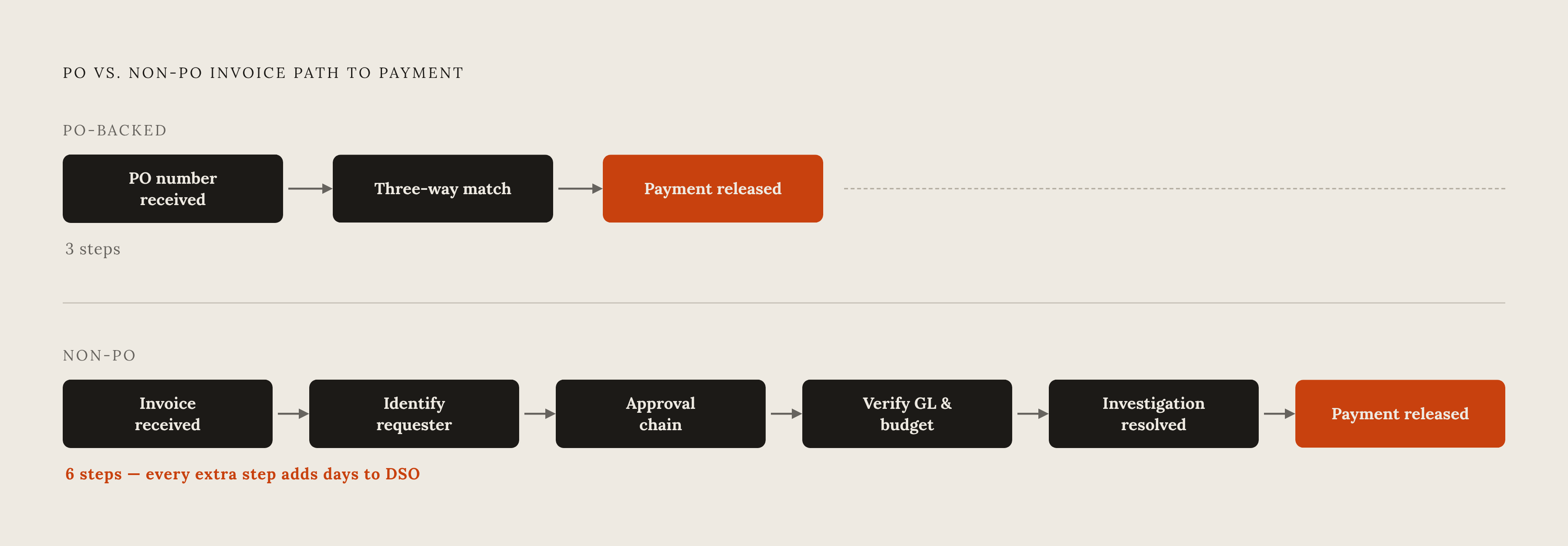
A PO invoice is basically pre-approved before it even reaches AP. Budget got checked, the vendor got picked, the price got agreed on, all of that happened back when the PO was cut. So by the time the invoice lands in AP, the job is verification. It's verification.
That's where three-way matching comes in. The system lines up the purchase order, the supplier's invoice, and the goods receipt side by side. If the three agree, payment moves forward with little or no human involvement. The PO number is what makes that possible, since it's the reference that links all three documents so a machine can do the comparing instead of a person.
Verification is fast. Investigation takes longer. That's the whole ballgame.
The absence of a PO turning every non-PO invoice into a multi-step investigation before payment can begin
Without a PO, AP can't just match and move on. They have to rebuild the authorization after the fact, like a detective working a cold case where half the witnesses have already left the building.
Before a non-PO invoice can even start toward payment, someone has to:
- Track down who in the business actually requested or approved the spend
Most companies run a layered approval chain for this kind of spend. Bigger or stranger expenses climb higher up that chain, and every rung adds more days. Manual processing of a non-PO invoice tends to take significantly longer than a PO invoice, and the gap is entirely made up of this detective work. The PO invoice skips the investigation. The non-PO invoice IS the investigation.
The specific disputes and holds that stall PO-backed invoices in collections
PO invoices aren't immune to holds, but the causes are narrower and a lot more predictable, which makes them fixable.
The usual suspects:
Goods receipt not posted yet: the invoice beat the receiving team to the punch, so payment waits on confirmation that the stuff actually showed up
Manual entry makes all of this worse. According to resolvepay.com, over 30% of purchase order discrepancies trace back to manual entry errors and inconsistent processing, and every mismatch resets the clock. Still, when a PO invoice gets held, the collector knows what's wrong. It's a specific variance with a specific fix, and the PO terms themselves are the ammunition for arguing the resolution.
How non-PO invoice disputes take longer to resolve than PO disputes
Dispute a non-PO invoice and there's no pre-agreed document to point to. The whole authorization history has to get pieced back together from contracts, statements of work, old emails, or, worse, somebody's verbal promise from three months ago that nobody wrote down.
The usual triggers:
- The buyer flat-out denies authorizing the spend, and there's no PO to prove otherwise
- Wrong or missing GL coding stalls internal routing, sometimes indefinitely
- The invoice arrives after the budget period closes, so the cost center technically has no money left
- The person who approved the spend has since changed roles or left the company entirely
AP on the buyer's side has no authority to approve non-PO spend on its own. It has to run the full routing gauntlet every time, which slows the timeline and puts real strain on the supplier relationship. A meaningful share of B2B invoices in North America get paid late or disputed, with resolution stretching across weeks or even months, and the non-PO path is a major reason why.
The payment velocity impact of the fraud and compliance risk non-PO invoices carry
Taking away the PO removes the primary checkpoint, the one thing that separates a real invoice from a made-up one. AP teams handling non-PO spend have to manually confirm the expense is legit, coded right, and within policy, with nothing pre-approved to anchor the check.
And the fraud landscape hasn't been sitting still. Payment fraud attempts remain a serious and persistent threat, with fake invoices showing up in the large majority of observed fraud patterns, usually paired with a fabricated email pretending to be someone real. A very large share of organizations report attempted or actual payment fraud in the prior year, and invoice manipulation is near the top of the list of attack methods. Every extra layer of manual review that non-PO invoices require is also an extra layer of exposure. Slower and riskier tend to travel together.
How invoice type shapes DSO outcomes and where collections intervention has the most leverage
DSO is just the sum of every delay stacked on top of each other across the invoice-to-cash cycle, and invoice type is one of the most reliable signals for where those delays pile up.
Non-PO invoices manufacture the gaps that stretch DSO out: missing authorization, wrong coding, an approver who can't be reached. Each one tacks on days, sometimes weeks, before the payment clock even starts ticking. A wrong or missing PO number can send an invoice bouncing back and forth between buyer and seller more than once, and a single error like that can add weeks to the collection cycle. Every dispute extends the time before payment can be collected. PO invoices are structurally built to avoid this. Non-PO invoices are structurally built to invite it.
Collections leverage lives almost entirely on the non-PO side. That's where the fixable friction sits.
Collections tactics that work for PO-backed invoices
Lead with the PO number every single time. Cite the number, the agreed delivery date, and the contracted price in the very first message. That alone kills the buyer's ability to claim they don't recognize the charge, because the paperwork already says otherwise.
If the hold is a matching exception, ask the buyer's AP team for the specific reason code. A price variance and a missing goods receipt need completely different follow-ups, so treating them the same wastes time on both sides.
For price variance, pull up the actual contract terms or amendment and compare line by line. If the gap falls inside a standard tolerance band, say so directly and ask for the tolerance policy in writing, so it doesn't become a recurring argument. For goods receipt delays, skip AP and go straight to the receiving team. AP frequently can't release payment until the GRN posts, and that timeline usually isn't theirs to control anyway.
Collections tactics that work for non-PO invoices
The whole challenge here boils down to one thing: proving authorization after the fact, before any conversation about payment can even start. Do that work up front. Don't wait for the buyer to bring it up first, because by then the invoice has already gone cold.
Before the first outreach even goes out, pull together the paper trail:
- The signed contract or statement of work
- An email approval from whoever in the business actually requested the work
- Delivery confirmation or a sign-off
- Any past payment history for similar work with the same buyer
Send that first message to the business owner who authorized the spend. AP has no power to approve without internal sign-off, so routing everything through them first just adds another lap around a track that's already too long.
Sources
- What is a non-PO invoice? PO vs. non-PO invoices explained
- PO vs. Non-PO Invoice Differences: Meaning, Automation, Advantages & Process | GEP Blog
- The difference between PO and non-PO invoices | Medius
- resolvepay.com
- PO and Non-PO Invoices: What Is The Difference? • MHC
- precoro.com
- tipalti.com
- procuredesk.com