Invoice Dispute Types in B2B and How to Categorize Them
Categorizing disputes by type routes each to the right team and speeds resolution.

The invoice goes out. The work gets done. And the cash doesn't arrive because the dispute stalls collection before it can be resolved. Any finance leader who's run accounts receivable for more than a quarter knows this exact feeling, and the instinct is usually to treat it as one problem: "the client hasn't paid." But conflating dispute types means applying the wrong response, and each one needs a different person, a different document, and a different fix. A billing error gets solved by someone in AR administration pulling up the original invoice. A fulfillment dispute needs a warehouse manager with a signed delivery slip. A contract disagreement might need legal on the phone. If disputes are treated like the same ticket in the same queue, the response will be wrong and resolution timelines will stretch out.
That's the mechanism driving most "slow" dispute resolution. Not a lack of effort. Understaffing isn't the cause either, though it doesn't help. The actual failure is diagnostic: nobody sorted the dispute before someone tried to treat it. A doctor who prescribes the same medicine for a broken leg and a head cold isn't working hard enough. The doctor just skipped the exam. That's what's happening across a lot of B2B billing departments right now, and it's why disputes that should take days to close take weeks instead.
The stakes here are bigger than a line-item squabble. Research cited in AgentCollect's State of B2B Payment Disputes report, drawing on PYMNTS 2025 data, puts the dispute-driven share of B2B payment delays at 40 percent. That means close to half of all overdue B2B invoices are stuck for reasons other than the customer's ability to pay. They're stuck because somebody never closed the loop on a documentation gap, an invoice discrepancy, or a misread contract term. Disputes also don't politely sit on the disputed portion of an invoice while the rest moves through. Cleavr's 2026 guide describes the common pattern: a client holds an entire large invoice hostage over one small incorrect line, and nothing gets paid until that single line gets fixed.
Disputes compound into a cash flow and operational burden
Wrong category leads to wrong team, wrong team leads to wrong documentation request, wrong documentation request leads to delay, and delay compounds into cost. Nothing about this is incidental. It's structural, and it repeats on every single misrouted dispute.
Resolving a dispute badly doesn't just take longer. It pulls in more people than it should. A case that should've gone straight to AR administration instead loops through sales, then operations, then sometimes legal, burning hours from departments that had nothing to do with the actual error. The GoAutonomous 2026 analysis makes the arithmetic blunt: once all that cross-functional time gets added up, a credit memo can end up costing more to process than it was worth approving in the first place.
The burden also scales with growth, catching teams off guard. GoAutonomous found that claims volume spikes a few weeks after a company goes through a growth phase. The logic is simple once you see it: during peak order volume, exceptions get waved through under pressure, just to keep shipments and invoices moving. Those exceptions don't disappear. They resurface as disputes once the invoice lands on the customer's desk. Growth, in other words, doesn't just bring in more revenue. It quietly stockpiles a backlog of future disputes, timed to arrive right when the team is least prepared for them.
Part of why this goes unmeasured is that no single department ever sees the whole bill. Finance sees the value of the credit memo. Operations sees the cost of return logistics. Customer service sees call volume and ticket time. Each team can point to its own small number and shrug. Nobody adds the three numbers together for a single dispute, so nobody realizes the real total. It's the accounting equivalent of three blind professionals describing an elephant: one describes a trunk, one a leg, one an ear, and nobody steps back to say "that's an elephant, and it's expensive to feed."
And the dollar figures rest on something harder to put on a spreadsheet. How a dispute gets handled says something to the customer about whether the relationship is worth keeping. InvoiceQuickly's 2026 guide states that how a dispute gets handled decides whether the relationship survives and whether the revenue gets collected. A customer who feels stonewalled on a legitimate delivery complaint doesn't just withhold one payment. They start shopping for a new vendor.
The five canonical B2B dispute types
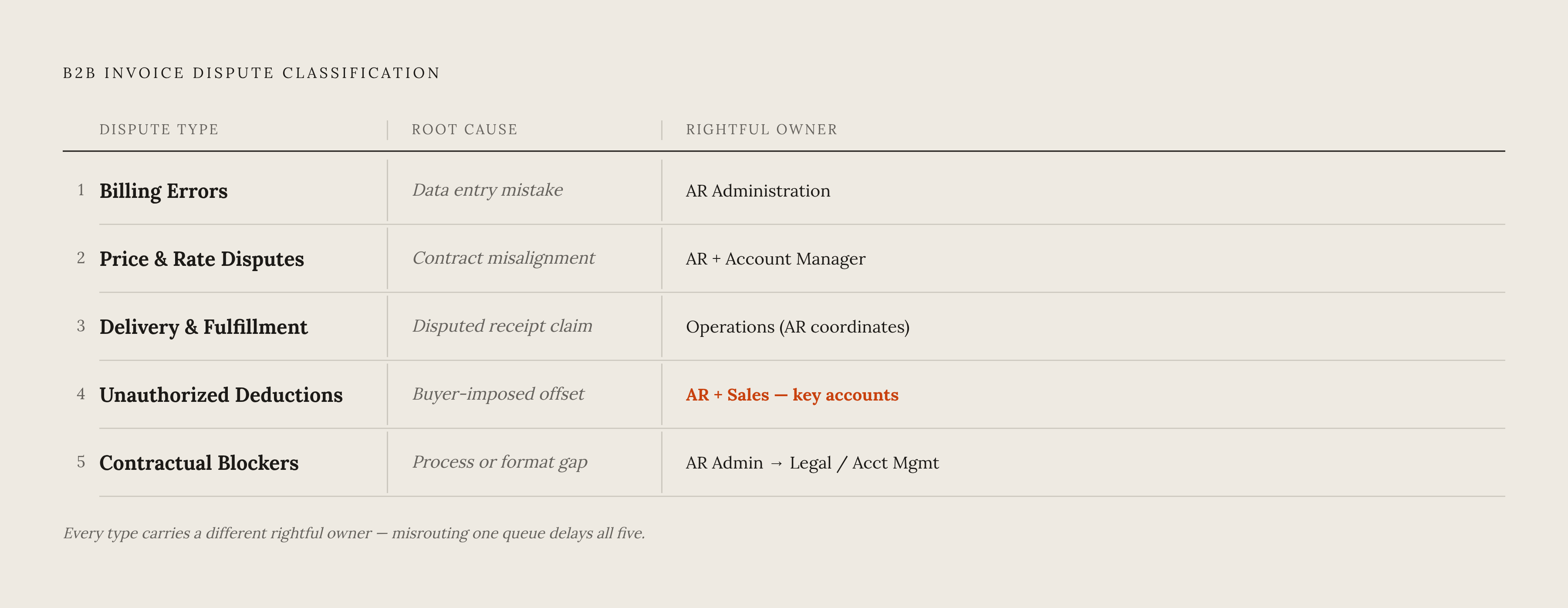
The fix starts with sorting disputes into categories that actually mean something operationally, not just administratively. B2B invoice disputes break down into five distinct types, each with its own cause, its own required evidence, and its own rightful owner inside the organization. Treating all five as one undifferentiated queue is the single biggest reason resolution drags on.
Billing errors are the first type. This is the most straightforward category: the invoice itself contains a factual mistake. Wrong amount. Incorrect purchase order reference. A VAT amount can also be wrong. Wrong currency. Wrong billing entity. These are typo-level problems, not relationship problems, but they completely block the client's internal approval workflow until someone fixes them. Resolution means issuing a corrected invoice with the supporting paperwork attached, and it belongs to billing or AR administration. InvoiceQuickly flags one version of this as especially common in enterprise accounts: an invoice gets rejected outright for missing a purchase order number. It's a quick fix. Left uncategorized at intake, though, that same five-minute fix can hold up payment for weeks.
Price and rate disputes are the second type. Here, the invoice is internally consistent, but it doesn't match what was agreed. The rate charged doesn't match the negotiated rate, a contracted discount never got applied, or a price change never reached the right person on the customer's side. Both Cleavr and GoAutonomous point to the same trigger: the invoiced amount diverges from the PO price or contract rate in place at the time of the order. B2B SaaS complicates this one further. DDD Invoices' 2026 finance guide draws a hard line between contract-change disputes, like upgrades, seat changes, or tier shifts, and genuine billing errors. Skipping the logging of a mid-cycle upgrade means the system bills against a stale contract state, which creates both a dispute and, eventually, an audit headache. Resolution means pulling the signed contract or PO, comparing it line by line against the invoice, and correcting the invoice if the discrepancy is confirmed. This one sits with AR, but it needs an account manager in the room to confirm current pricing.
Type 3: Delivery and fulfillment disputes. The customer says the goods or services never showed up, showed up incomplete, missed a quality bar, or arrived damaged. Resolution requires proof of delivery, a signed acceptance record, or documentation that the service was actually completed, and it sits with operations or logistics, with AR coordinating in the background. This is the category where a quick fix isn't available even in theory. InvoiceQuickly points out that quality and scope disputes need the most careful handling: the fix isn't a corrected invoice, it's a structured conversation anchored to the original statement of work or the agreed acceptance criteria. Construction is the clearest example of how messy this gets. Progress billing, lien waivers, change orders, and retainage calculations all feed into this category. When a general contractor pushes back on a draw because a milestone wasn't technically met, the AR team is untangling a documentation and workflow problem, not chasing a late payment. They're untangling a documentation and workflow problem that occurs within an invoice.
Type 4: Unauthorized deductions and short payments. This one looks like a payment, which makes it sneaky. The customer pays less than the invoice says, without explaining why, or they cite a credit note the finance team has never seen. Cleavr draws a sharp line here that's easy to miss: a dispute is something the client actively raises and challenges, while a deduction is a partial payment with no explanation at all. Both block the same cash, but they call for different responses. Retail and FMCG supply chains run into this constantly: buyers take deductions for trade promotions, damaged goods, or compliance failures, often without sending documentation anywhere near on time. Resolution starts with a written request for justification. If a credit note gets cited, reconcile it against AR's own records. If nothing checks out, it escalates into a formal dispute process, and it sits with AR, with sales pulled in for key accounts.
Type 5: Contractual and administrative blockers. This category splits into two related problems: the first is a contract term conflict, where the customer claims the invoice terms don't match what was agreed, whether that's payment date, discount terms, or scope. AgentCollect's 2026 report lists this as one of its four master dispute categories, and resolving it means pulling the original contract and purchase order to show what was actually agreed. The second is an administrative blocker: the invoice can't even get processed because of a format or routing failure, like a wrong contact, a format the client's system won't accept, or a supplier portal that was never updated. Cleavr treats this as its own sub-type, and for good reason: it's not really a dispute in the traditional sense, but it blocks payment just as completely as one, and outdated supplier portals are a routine culprit in large enterprise accounts. Duplicate invoices live here too. A customer gets billed twice for the same job, pays one invoice, and assumes they're square. AgentCollect notes the debtor genuinely believes payment is complete, and untangling it takes invoice reconciliation plus a credit memo. Contract conflicts get resolved by pulling the contract and PO and putting the agreed terms in writing, with AR handling it and legal or account management stepping in for anything complicated. Administrative blockers get resolved by simply resubmitting in the right format to the right contact, and that stays inside AR administration.
Sector and contract structure shift which dispute types dominate
B2B invoice disputes fall into five distinguishable categories, each with a distinct cause, a distinct set of evidence required to resolve it, and a distinct internal owner. But which ones dominate, and how much evidence each one demands, shifts a lot depending on the sector, the contract model, and the kind of customer on the other end of the invoice. Knowing a company's own dispute mix in advance is what makes a categorization system actually useful instead of just theoretically tidy.
Retail and FMCG lean heavily on deduction disputes. Trade promotion chargebacks, compliance penalties, and damaged goods claims pile up fast, and buyers routinely deduct first and explain later, if at all. The bottleneck in this sector usually isn't identifying the dispute; it's getting the customer to actually produce the paperwork backing up the deduction they already took.
Construction runs into the opposite problem: fewer disputes, but each one is tangled. Progress billing, change orders, lien waivers, and retainage all stack on top of each other, and a single project can generate a different dispute type at every milestone. The AR team on a construction account is frequently solving a project management problem that happens to arrive looking like a billing problem.
B2B SaaS has its own quirk: usage discrepancy disputes. DDD Invoices' 2026 guide identifies these as a category unique to subscription and usage-based billing, where the numbers in the billing system don't match the usage logs. Fixing this means reconciling the usage logs and issuing a revised invoice. Crucially, this has to get separated from contract-change disputes (seat changes, tier upgrades) right at intake, or the actual root cause never gets found and the same mismatch keeps recurring.
Across enterprise B2B broadly, contract term conflicts and administrative blockers climb as procurement gets more bureaucratic. Supplier portal requirements from platforms like Coupa and Ariba have created an entire category of disputes that have nothing to do with price or quality. They're pure process failures on one side of the transaction or the other. GoAutonomous's Mediq case shows how volume and timing interact here: a healthcare distributor moving thousands of orders per week across Nordic markets saw its dispute volume spike weeks after a period of fast growth. Exceptions that got waved through during the busy stretch came back to bite once the invoices finally landed.
Why finance teams cannot act on their dispute data
Most finance teams aren't failing because the taxonomy above is hard to learn; they're failing because nobody applies it in the first place. The core structural problem in most dispute processes is that there's no classification happening at all. Without that, nobody can say how many invoices are stuck on PO errors versus delivery disputes versus deductions. Nobody can route a case to the right team on the first try. And nobody can measure what's actually driving disputes month over month.
Cleavr's 2026 guide lays out what this looks like in practice at most companies: a collections agent notices a payment is late, calls the client, and forwards whatever they learn to accounting or an account manager, mostly by email, mostly without any consistent format. The case gets resolved, eventually, whenever someone happens to remember it's still open. There's no classification tagging the dispute type, no central system tracking where it sits, and no performance data showing whether the team is getting faster or slower over time.
Applying price and rate dispute categorization at the moment a dispute is logged, instead of after it's already caused a delay, is the fix. A billing error gets tagged and routed to AR administration before it ever reaches a collections agent's inbox. A delivery dispute gets flagged for operations with the SOW attached from day one. A deduction gets a written justification request sent out automatically instead of sitting in a queue waiting for someone to notice it. None of this requires new negotiating leverage with customers or a bigger headcount in AR. It requires sorting the problem correctly before anyone tries to solve it, which is the one step most finance teams still skip.
Sources
- B2B Claims and Dispute Processing
- 2026 State of B2B Payment Disputes — AgentCollect Report
- B2B Dispute Management: How AI Resolves Payment Blockers
- The Complete Guide to Invoice Dispute Resolution in 2026
- B2B SaaS Invoice Dispute Resolution: A Finance Guide
- Invoice Dispute Management: Reduce AR Disputes Faster