Dispute Resolution Clauses in B2B Payment Terms
Vague dispute clauses let buyers hold entire invoices hostage.

A large share of B2B payment delays start with a disputed invoice, not a buyer who simply can't pay. That's the real story here: the delay is built into the contract, not forced by anyone's bank balance.
The gap sits between what a payment clause says and what actually happens the moment a buyer objects to something on the bill. On paper, the invoice is due in 30 days. In practice, if the contract never spells out what counts as a valid dispute, when the buyer has to raise it, or what happens to the parts of the invoice nobody's arguing about, the buyer can sit on the whole amount for as long as they like. Nobody broke a rule. There was no rule to break.
That's the quiet failure mode in a lot of commercial contracts: silence reads as permission. A buyer who wants to slow-walk payment doesn't need to lie or stall in bad faith. They just need a clause that never told them they couldn't.
The weight of that falls hardest on smaller suppliers. They're the ones least likely to have a legal team pushing back on day one, and least likely to escalate once a payment goes sideways. Chasing a disputed invoice through a vague contract costs time and money most small shops don't have lying around, so a lot of them write off the loss and move on. The clause didn't just fail to protect them. It handed the other side a free delay tactic.
Where dispute language fits among payment terms clause components
A payment terms clause is less a single rule and more a small machine with several moving parts. The due date is one lever. Late fees are another. Interest on overdue amounts is a third. How disputes get handled is a fourth, and it's just as load-bearing as the rest.
Two contracts can both say "Net 30" and behave in completely different ways depending on how those levers are set. One version pays out like clockwork. The other turns into a six-month standoff the moment someone flags a line item they don't like. The words "Net 30" tell you almost nothing on their own.
The dispute-handling piece doesn't sit off to the side as some separate legal appendix. It sits right next to the supplier's suspension rights (the ability to pause work or deliveries over nonpayment), and the two interact constantly. Draft one without thinking about the other, and you leave a gap. Buyers tend to find gaps.
Most teams read the net term at the top of the clause, nod, and skim past everything underneath it. That's how weak dispute language slips through unnoticed, sitting quietly in a signed contract until the day it actually matters, which is usually the day a six-figure invoice is on the line.
The undisputed-amounts carve-out, the single highest-leverage drafting change
If there's one line to get right in a payment clause, it's this one: the buyer has to pay the undisputed parts of an invoice on time, even while the disputed part gets sorted out.
The standard version works like this. The buyer notifies the supplier in writing before the due date. The notice names the specific line item in question and includes whatever documentation backs up the objection. Everything else on the invoice, the parts nobody's contesting, gets paid on schedule. Both sides then work in good faith to settle the disputed portion within a set window.
Without that carve-out, a buyer can object to a small line item on an invoice and hold the entire invoice amount hostage, perfectly within their contractual rights. The supplier's only real option at that point is litigation, which costs more than the disputed amount was ever worth.
The carve-out doesn't speed up how the argument over the disputed line gets resolved. It changes what still has to move while that argument plays out. That's the whole point, and it's the single cheapest insurance policy a supplier can write into a contract.
Notice requirements and timelines, the mechanics that give the clause its teeth
A dispute clause with no deadlines attached is a nice paragraph and nothing more. It describes a process without ever telling anyone when the clock starts, when it runs out, or what happens if someone just ignores it.
Notice requirements fix that. The buyer has to raise any dispute in writing before the original due date, name the specific reason for the objection, and attach the documentation to back it up. A clause that lets a buyer dispute an invoice "at any time" doesn't really have a net term. Net 30 and "whenever" can't both be true.
The consequence matters as much as the deadline. If the buyer misses the notice window, the invoice is deemed accepted and the full amount comes due on the original date, no exceptions.
The combination of a payment carve-out with no notice deadline and no definition of good faith is a known vulnerability. It's the drafting equivalent of installing a lock on the front door and leaving the back door wide open. Vague trigger dates compound the problem: if both the dispute window and the due date are loosely worded, a buyer can raise a late objection and argue the clock never properly started. Two fuzzy dates are worse than one.
Escalation paths, structuring the route from negotiation to binding resolution
Once the initial resolution window closes and nobody's agreed on anything, the contract needs a next step already built in. A tiered escalation clause, laying out the path from direct talks to mediation to a final binding method, is now close to standard in enterprise contracts. What makes it work is how precisely each tier is defined.
The usual sequence runs three steps. First, direct negotiation between senior people on each side, with a hard time limit attached. Second, mediation, with a named mediator or a clear process for picking one. Third, a final and binding method, arbitration or litigation, if the first two don't land.
Each handoff needs its own clear trigger. What actually counts as the negotiation tier failing? Either side can put it in writing that they're at an impasse, or the clock on that tier simply runs out, whichever comes first. Without that kind of specificity, a party can later argue the earlier tier was never really finished, which stalls everything downstream.
Some contracts narrow the scope deliberately, sending only payment disputes to arbitration while routing everything else to court. That keeps arbitration's cost and privacy where they actually matter, the payment fights, rather than spreading it across every disagreement the contract could possibly produce. Courts and tribunals can also treat a skipped escalation step as a jurisdictional problem, adding delay to the very process meant to avoid delay.
The honest complaint about multi-tier clauses is that they can be gamed. A party drags out "good faith negotiation" for months while the invoice ages and the money sits parked. The fix is to put a hard deadline on each tier.
Arbitration versus litigation for payment disputes, what the choice costs
Picking arbitration over litigation for payment disputes isn't about which one wins some abstract contest for "better." It depends on how big the claim is, how much confidentiality matters, and whether the other party sits across the street or across an ocean.
Arbitration's strongest selling points: proceedings stay private, while litigation filings become public record. Arbitration awards also travel across borders more easily than court judgments, enforceable under the New York Convention in ways a domestic court ruling often isn't. And an arbitration clause can be scoped narrowly, covering payment disputes specifically without forcing every future disagreement into the same box.
None of that makes arbitration free, and for smaller claims it can actually cost more than going to court. Arbitrators bill by the hour, judges don't send an invoice. For a straightforward dispute over a modest amount, one that a court could resolve fairly quickly anyway, arbitration's hourly meter can outrun the value of the claim itself. Creditors who insist on arbitrating in their own home turf sometimes end up dropping claims altogether once they do the math and realize the legal bill will eat the recovery.
Venue is its own separate decision, apart from arbitration versus litigation. Resolving a dispute where the debtor is located tends to be cheaper and faster than dragging the case to the creditor's home jurisdiction. Picking your own backyard looks good on paper and can quietly make the clause harder to enforce where it counts.
Speed isn't really the deciding factor either way. Large-dollar B2B arbitration cases and first-instance judgments in US District Court both typically take months to years to resolve. The real value of a well-drafted dispute clause is keeping the fight from reaching either of those finish lines. Winning after two years in arbitration is still two years.
How payment-hold rules interact with suspension rights
A buyer's right to withhold payment and a supplier's right to suspend work are two halves of the same standoff. Draft them separately and each side ends up holding a lever the other side didn't account for.
The dangerous version gives the buyer an open-ended right to withhold payment, no notice deadline, no obligation to pay the undisputed parts, while the supplier gets a no-notice right to suspend delivery. Now both sides are holding a weapon with no safety on it, and there's no built-in off-ramp once the argument starts.
The safer version ties suspension to a clear sequence: written notice goes out, a cure period runs, and only after undisputed overdue amounts stay unpaid past that point can the supplier actually suspend. Suspension never applies to amounts that are genuinely under dispute and that meet the notice and payment terms laid out elsewhere in the contract. Each right gets boxed in by the other.
Interest provisions sit inside this same mechanism. A steep or compounding interest rate on withheld amounts changes what each side is incentivized to do, and in some jurisdictions a rate like that can get challenged as disproportionate. That's one more reason suspension rights and payment-hold rules need to be written in the same breath rather than in two different sections of the contract that never talk to each other.
Jurisdictional rules that limit what a dispute clause can say
Contracts don't get drafted in a vacuum, and a few recent regulatory moves have narrowed how much freedom parties actually have over payment terms and dispute handling, especially where EU or UK counterparties are involved. A clause that ignores them can turn out to be unenforceable the moment it's tested.
The European Court of Justice, in a judgment dated 6 February 2025, clarified a formal requirement that already existed on paper: payment terms longer than 60 days are only valid if both sides genuinely agreed to them. The longer term has to be clearly highlighted in the contract rather than buried in standard boilerplate, though the parties don't need to have individually negotiated every word of it. A 90-day term quietly tucked into paragraph 40 of a standard terms document is exactly the kind of thing that's now contestable.
The UK's Commercial Payments Bill 2026 takes a parallel approach: a 60-day cap on payment terms, stronger enforcement powers for the Small Business Commissioner, and mandatory reporting requirements. The EU and UK got there by different routes, but they landed on the same outer limit.
On the dispute resolution side, UK courts have leaned harder toward pushing parties into mediation before litigation since the Churchill v Merthyr Tydfil ruling in November 2023. Combine that with the Arbitration Act 2025, which cleaned up the rules on governing law and arbitrator disclosure duties, and alternative dispute resolution is becoming the expected first move for any dispute seated in the UK, not just one option among several.
None of this closes off good drafting. It just narrows the lane. Drafters who know where the 60-day line sits, and who know UK courts expect mediation before anyone shows up with a lawsuit, can still build a clause that does what the business needs. They need to build it inside those boundaries.
Anatomy of a well-drafted dispute clause
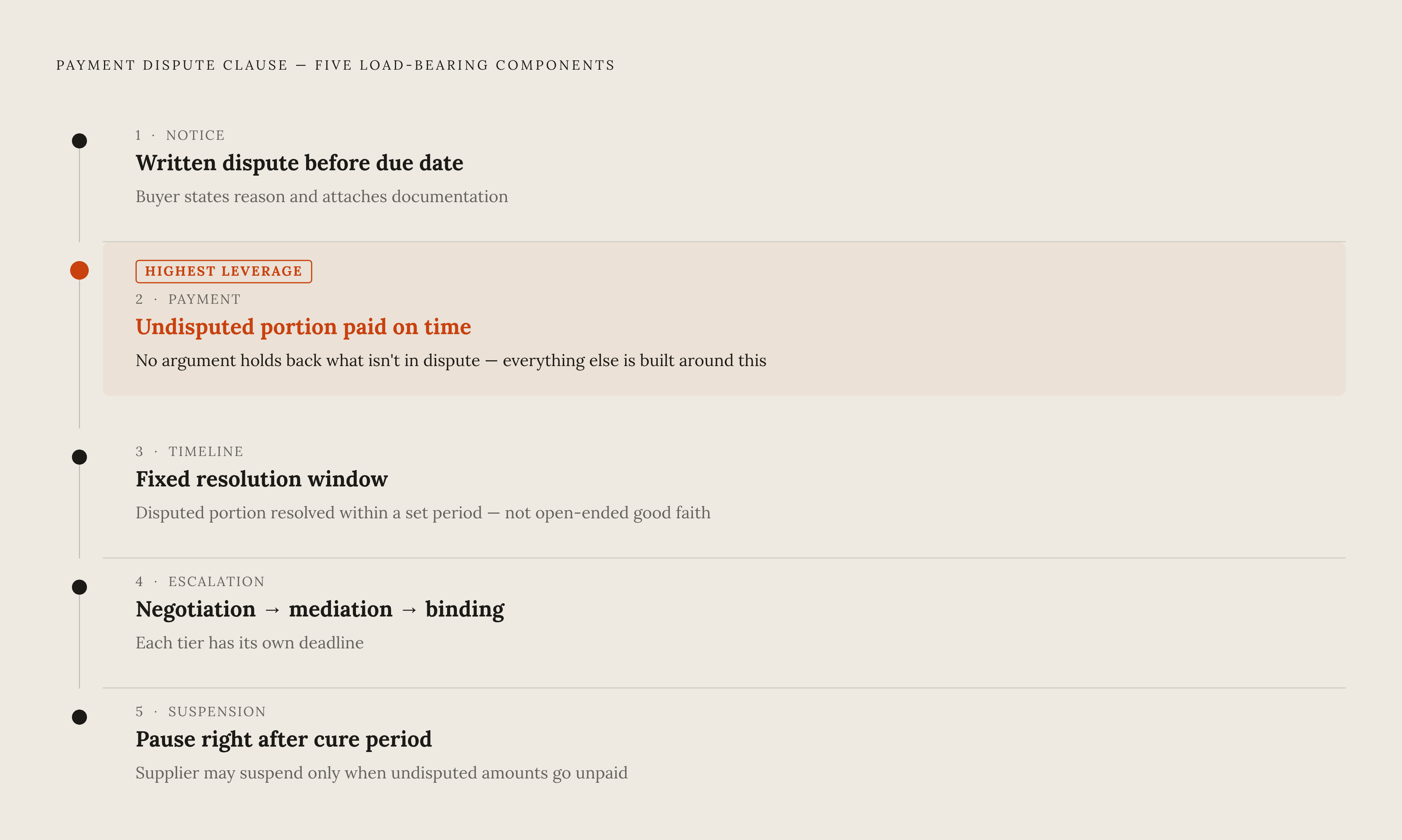
A solid payment dispute clause covers five things, each doing one job, with nothing left unaddressed between them.
Notice: the buyer has to raise any dispute in writing before the due date, state the reason, and attach documentation.
Payment: the undisputed portion of the invoice gets paid on time regardless of what's being argued over.
Timeline: the disputed portion gets a fixed resolution window, not an open-ended "good faith" promise.
Escalation: a defined sequence runs from negotiation to mediation to a final binding method, each tier with its own deadline and a clear trigger for moving to the next one.
Suspension: the supplier's right to pause work only kicks in after undisputed amounts go unpaid past a cure period, and it never touches amounts under a properly raised dispute.
Leaving any one of those five out gives a buyer with a good lawyer, or just a strong incentive to delay, a door to find.
Sources
- Let the Pen Be Your Sword: Crafting Powerful ADR Contractual Provisions
- ADR Clause Workbook
- Arbitration vs. Litigation: Which Is Right for Your Dispute?
- How to Resolve B2B Disputes with Arbitration
- Arbitration vs. litigation: The differences
- Why Arbitrate? Why Not? The Benefits of Arbitrating Commercial Disputes