Collections-as-a-Service Providers for Mid-Market B2B Finance Teams
Outsourced collections work bridges the gap between AR software and recovery agencies.

Collections-as-a-Service for mid-market B2B finance teams means buying ongoing collections execution. It fills the gap between self-serve AR software and late-stage recovery agencies by handling follow-up, disputes, portal work, and escalation. The right fit depends on why cash is held up: collection work is unfinished, recovery efforts have run out, or payment terms leave the business waiting too long.
Why mid-market B2B finance teams are caught between two inadequate options
An AR manager at a mid-sized distributor can face several different jobs behind one overdue balance. The invoice may need submitting through a supplier portal, the customer may be missing a W-9, or an agreed payment term may not match the record. Meanwhile, other accounts need routine follow-up or a conversation about a dispute. The aging report shows how long the money has been overdue. It does not explain what will release it.
That workload sits awkwardly between the two traditional buying options. Enterprise AR platforms built for Fortune 500 scale can require implementation time and IT resources that mid-market teams rarely have. Contingency-fee agencies, by contrast, are designed for late-stage recovery and take a share of the money collected. They enter the customer relationship when the conversation is already difficult.
Mid-market businesses have enough invoices and payment-term complexity to overwhelm informal follow-up, but not necessarily enough staff to operate an elaborate platform. More software can leave the work sitting in a better-looking queue. An agency can arrive too late to prevent that queue from aging.
What Collections-as-a-Service actually is, and what it is not
CaaS bundles follow-up, dispute handling, portal navigation, and escalation into a managed service. The provider acts as an extension of the finance team, doing collection work. Execution is the dividing line between the models. A dashboard that recommends a call still leaves someone on the seller’s payroll responsible for making it.
Consider the same overdue invoice with two possible causes. If it is waiting on a missing W-9, the fix is document completion. If the payment terms do not match, the fix is resolving that mismatch. Another reminder does neither. The overdue balance looks the same, but the intervention has to change.
CaaS can include human-like or human-assisted outreach, work inside Coupa or Ariba, and escalation that needs judgment. Software may power the service, but software access is not the deliverable.
Nor is CaaS the same as engaging a contingency agency after an invoice becomes 90+ days overdue. It operates upstream on current and aging AR, addressing late invoice dispatch, portal friction, missing documents, and inconsistent follow-up. Recovery agencies can still have a role later. The distinction is when they enter and what work they take over.
The three provider types competing for mid-market AR mandates
The first model is an AI-native software platform with a managed-service overlay or human escalation layer. It automates work such as dunning, payment scoring, and cash application and has a way to handle exceptions. Sidetrade’s Aimie engine draws on a large pool of payment experiences and tens of millions of buyers, giving its scoring cross-customer signals. Quadient AR, formerly YayPay, is designed for mid-market teams that need payment likelihood scoring and collector performance tracking without a long enterprise implementation. The buyer’s question is how much execution comes with the platform.
The second model combines AR automation with financing. Resolve Pay advances cash within days on approved invoices and gives the business non-recourse protection if those approved buyers default. It says it fits B2B ecommerce, distribution, and wholesale businesses that offer net terms. This changes the job being purchased. Rather than only improving collection timing, the model provides liquidity and transfers default risk for approved buyers under the financing arrangement.
The third model is contingency-fee recovery, which businesses generally turn to after accounts pass their internal collection limits, typically 60–90+ days overdue. Atradius Collections offers cross-border B2B recovery through local-language collectors, regional legal expertise, and its Agora portal. The Kaplan Group specializes in commercial collections, with tiered contingency pricing and legal escalation through an in-house law firm and a nationwide attorney network. These providers focus on recovering difficult overdue accounts. Their mandate differs from keeping current receivables moving.
These are different delivery models. A company can use managed execution for current AR, financing where payment terms create a cash gap, and an agency for exhausted recovery cases. None automatically replaces the others. Confusing them can mean paying recovery fees for work that belonged much earlier in the process.
What AI is actually changing in collections execution — and what it isn't
AI is useful where collections depends on sorting, predicting, matching, and repeating. It can prioritize accounts, estimate payment likelihood, sequence dunning, match remittances, and triage disputes. That gives collectors a more focused workload.
Sidetrade’s Aimie agents illustrate what agentic AI means in practice. They can autonomously run outbound dunning through calls and emails, match incoming remittances, and triage disputes. They also support credit decisioning by combining internal payer data with external credit bureau and insurer feeds. This goes beyond a fixed reminder schedule. The tasks an agent completes provide a useful basis for evaluating the sales deck’s “AI” claims.
Portal friction, missing compliance documents, and escalation that could strain a customer relationship can still need a person to step in when automation alone falls short. A missing W-9 is not suffering from a shortage of reminders. Persistent follow-up remains necessary, but it has to respond to the reason payment stopped.
Building custom workflows is also more accessible through agentic coding tools. Yet a production system still needs engineers to keep it running and handle ERP version changes and portal updates. The build option exchanges some upfront cost for ongoing technical responsibility.
A separate limit applies even when execution works well. Even with faster follow-up, long payment terms leave a cash-flow gap. Embedded invoice financing, such as Resolve’s model, addresses that gap by advancing cash.
The evaluation criteria that actually differentiate CaaS providers for mid-market teams
For a VP of Finance, the vendor conversation should start with the work causing days sales outstanding to drag. “Which of these blockers will your team resolve, and when will that service be live?” is more useful than a tour of every feature. Implementation speed has a cash-flow consequence. A six-month rollout leaves a team with aging AR waiting for the proposed remedy while the existing workload continues.
Integration depth deserves the next question. “Will payment updates write back directly to the ERP in real time, or arrive through batch updates?” distinguishes a closed cash-application loop from a slower connection. Native integration with systems such as NetSuite, Sage Intacct, and QuickBooks Online should be examined at that level. Friday afternoon is a useful test case. A payment that comes in then needs to be recorded correctly before Monday’s aging report.
“Who submits invoices through Coupa or Ariba, and who resolves missing W-9s, insurance certificates, or vendor onboarding forms?” puts responsibility in plain sight. A software-only platform that does not navigate required portals leaves that work unresolved. The same test applies to disputed invoices and unresponsive customers. If the provider produces an alert but has no escalation path, the task returns to the finance team.
Pricing should then be matched to the mandate. Subscription or flat-fee services suit ongoing AR work, while contingency pricing rewards recovery of already-overdue balances. Non-recourse financing gives the business a different deal by taking on the credit risk for approved buyers and invoices. These are not interchangeable savings claims. The comparison needs to distinguish payment for execution, payment for recovery, and payment for liquidity and risk transfer.
“How will outreach use the seller’s brand voice, and when will a sensitive account move to a person?” tests whether the service can preserve a valued relationship. Managed execution starts before an account becomes a serious recovery problem.
When to use which model — and how to sequence them across the AR aging curve
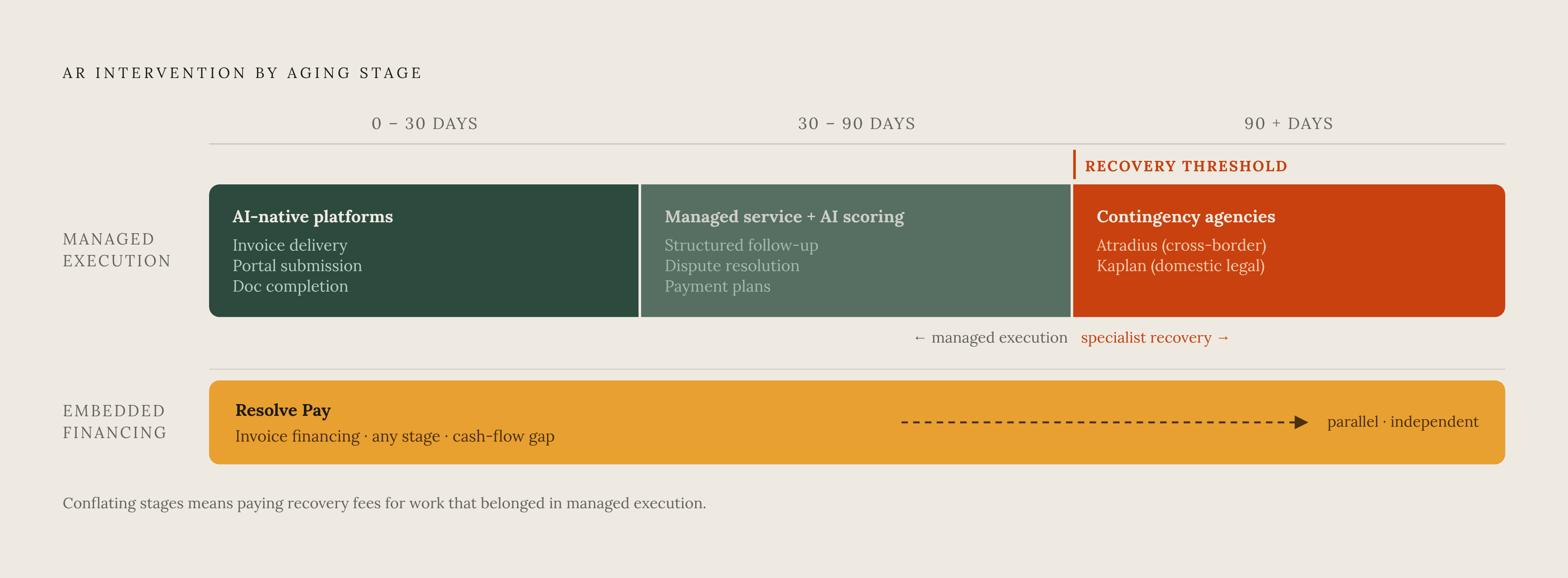
Early on the aging curve, the work is invoice delivery, portal submission, and document completion. Managed AR execution and AI-native platforms that people oversee fit that job. Contingency agencies have no role at this stage. The aim is to clear administrative barriers before an otherwise payable invoice becomes a collection problem.
As invoices move into mid-aging, structured follow-up, contact with the customer’s AP department, and dispute resolution become more important. This remains managed-service territory. AI scoring can help identify accounts at risk of slipping further, while the service handles the response. Later in mid-aging, human-driven outreach, payment-plan negotiation, and escalation to sales or account management need more relationship context than automated dunning supplies.
At 90+ days, accounts that have exhausted managed-service escalation become candidates for specialist contingency recovery. Atradius fits cross-border and international cases, while Kaplan fits domestic commercial accounts requiring legal escalation. Age alone is not the whole decision. An appropriate handoff accounts for the work already attempted and the remaining recovery path.
Investing in early managed execution reduces the number of accounts reaching late-stage recovery and the associated contingency-fee costs. Financing belongs on a separate track when waiting through agreed payment terms is itself the problem. Resolve’s model addresses liquidity independently of collection timing, subject to approved invoices and buyers.
The practical choice is therefore a division of work across the aging curve. That division only functions if responsibilities remain clear when an account moves between providers. Handoffs are where the contract earns its keep. Scope, escalation terms, and data access need to be settled before the first difficult account tests them.
What to verify before signing a CaaS contract
“Does the contracted service send emails, make calls, navigate portals, and submit documents, or does it recommend those actions to our staff?” separates execution from reporting. The answer should say who does each task. Otherwise, the buyer may acquire a more articulate to-do list.
The technical questions should be equally concrete. “Do payment status updates write back to the ERP in real time or in batches, and what lag should finance expect?” exposes a potential gap in cash reporting. “Which of Coupa, Ariba, and SAP Business Network do you actively navigate?” should produce a written coverage list. General claims of portal “support” are not enough. The contract needs to distinguish operating inside a portal from leaving that step to the customer.
“When and how does an account move from managed execution to an agency or legal collection, and who manages that transition?” prevents an ambiguous handoff. “Are legal collection costs included, and does formal litigation change the contingency rate?” tests pricing transparency. Kaplan’s in-house law firm performs a second collection effort at the same pre-agreed contingency rate, while formal litigation has a higher rate.
Offboarding deserves a clear answer before onboarding begins. “Can AR history, communication logs, and payment data be exported in a standard format?” establishes whether the company can leave without its collection history becoming stranded. Proprietary formats can make switching costly.
“Will the dashboard show real-time performance, what work has been completed, and what still requires action from our team?” tests whether finance can oversee the service without reconstructing it manually. A polished display is not evidence of completed collection work. If the provider cannot explain that distinction clearly, the “service” may be software with a support ticket queue.


