Credit Card Decline Recovery for B2B Subscription and Services Billing
Soft declines need retries; hard declines need new payment methods.

Credit card decline recovery for B2B subscription and services billing is not one problem with one fix. The cause determines the correct action, whether that means refreshing card details, waiting to retry, requesting a new payment method, or asking the customer to call their bank. Treating every decline alike leaves recoverable revenue untouched and can turn a billing problem into a compliance problem.
Why B2B subscription billing has a structurally different failure profile than B2C
B2B customers often need the services they have under contract to keep their businesses running. They are less likely than consumers to silently abandon a subscription after a failed payment, which gives B2B billing a higher recovery ceiling. Larger, longer-lived invoices also put more lifetime value at risk when a charge fails. A declined payment is therefore not just this month’s missing cash.
That distinction matters because involuntary churn means losing customers who did not choose to leave. Payment execution failures cause involuntary churn. Commercial cards can also run into issuer controls based on how consumers spend, which can cause false declines when businesses make legitimate purchases. The useful diagnostic is why the payment failed.
The master classification: soft versus hard declines, and why conflating them destroys recovery
The first division is between soft and hard declines. A soft decline means the card is still valid, but something temporarily blocked the charge. The cause is often insufficient funds, a processor timeout, a daily spending limit, or a bank-side fraud flag. Most recurring-payment failures fall into this category, making it the main opportunity for recovery. But even a temporary block can need more help to clear than another attempt alone.
A hard decline is a categorical refusal, such as a stolen card, a closed account, or an invalid card number. Retrying the same credentials cannot repair that problem and may trigger fraud flags against the merchant. Mastercard’s MAC 03 code, “Do Not Try Again”, requires cardholder action and carries a per-attempt penalty for retries. Visa Category 1 codes, including lost card, stolen card, closed account, and stop payment, should never be reattempted, with even one additional attempt counting as excessive.
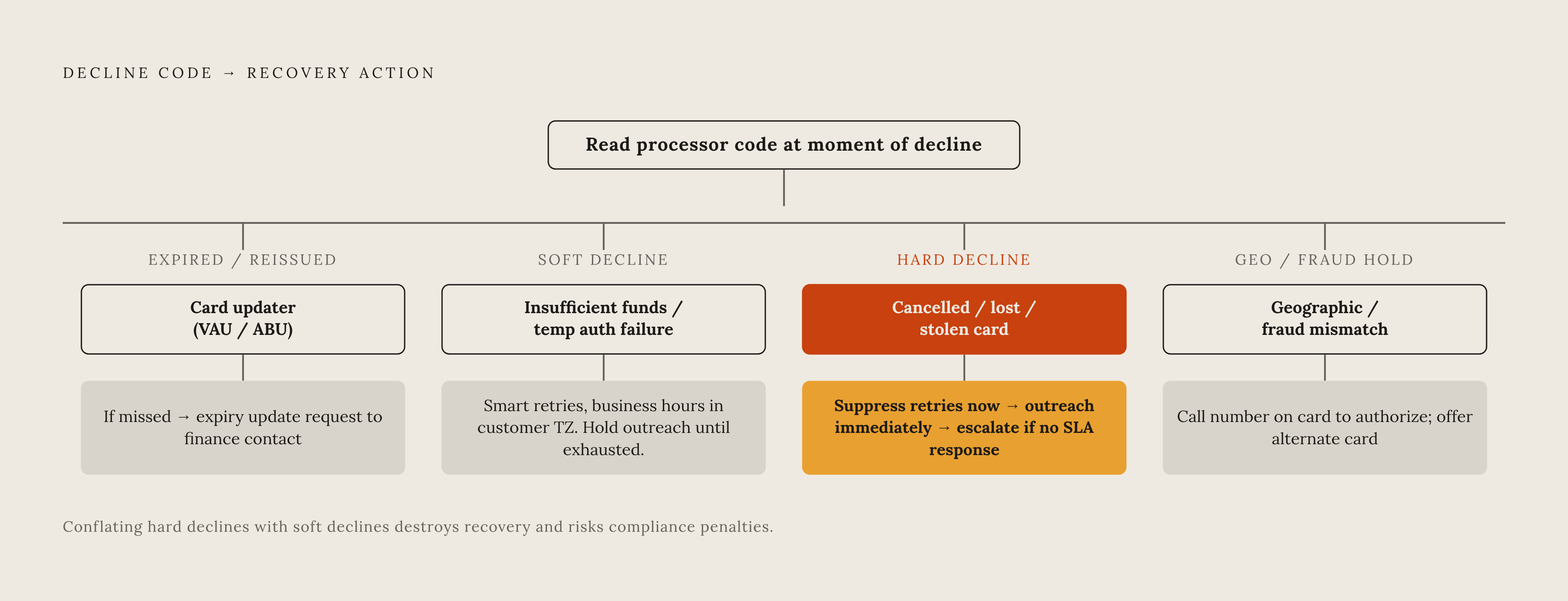
The processor response code must therefore be read before a retry or message fires. It is the switch that routes the transaction toward another attempt, fresh credentials, or customer intervention.
Expired and reissued cards: the highest-volume failure category and why it nearly always recovers silently
Expired and reissued cards are the most common cause of failed subscription payments. Banks replace cards for reasons that include preventing fraud, EMV chip upgrades, and contactless replacements. The customer activates the replacement but forgets the subscriptions attached to the old details. The service is still wanted, but the billing credentials have missed the move.
Automated card updater services fill this gap so customers do not have to remember every recurring charge. Visa Account Updater and Mastercard Automatic Billing Updater refresh stored details when cards are reissued, before the next billing attempt. Stripe’s Card Account Updater provides this coverage for participating issuers. Network tokenization adds protection by letting the network update the stored token when the card changes.
Coverage is not universal, so an issuer outside the updater network can still leave stale details on file. In that case, the message should explain that the card expired and offer a one-click update path. In B2B, that request may need to go to someone in finance rather than the person who decides on the subscription. A clear instruction is only useful if it reaches someone who can carry it out.
Insufficient funds and soft authorization failures: where retry timing determines whether revenue is recovered or lost
For insufficient funds and temporary authorization failures, the critical question is when to retry. The card is valid, but the charge arrived when the account could not cover it or an authorization check was pending. Another attempt can succeed after that condition changes. An immediate repeat, by contrast, may simply ask the bank the same question while nothing has changed. Persistence is not a substitute for timing.
Smart retries take into account when paydays fall and how issuers behave. In B2B, timing must also account for commercial-card fraud models, which can view out-of-hours charges with greater suspicion. Retries should therefore run during business hours in the customer’s time zone.
Messages to customers should usually wait while these recoverable soft declines go through the retry window. An email for every failed attempt makes a short-lived problem with processing look like an account crisis. If retries exhaust, cause-specific outreach becomes appropriate. Until then, silent recovery avoids asking the customer to solve a problem the billing system can handle, provided retry volume stays within network limits.
Hard declines from cancelled, lost, or stolen cards: where retries must stop and directed customer communication must begin
A cancelled, lost, or stolen card calls for the opposite approach. Once the processor finds a hard decline, retries must stop right away and contact with the customer must begin. To recover the payment, the billing system needs payment details that work, because charging the unusable ones at a different hour will not help. The retry engine has reached the end of its job.
The message should state that the bank declined the card, explain that cancellation or reissue can cause this, and provide a one-click update path. It should not imply that the customer did something wrong. A card reported stolen is already an inconvenience.
B2B accounts add an organizational complication because the original cardholder may no longer be the right contact. The card might belong to a former employee or have been cancelled after a procurement change or account restructuring. The workflow needs a route to the current finance contact rather than an endless sequence to the original owner. Speed matters here because every day before the update leaves the subscription exposed to lapse or cancellation for non-payment.
Geographic and fraud-mismatch holds: the category where neither retrying nor card-updating solves the problem
An issuer fraud hold can block a valid, funded card. A charge across national borders, an unusually large transaction, or several recent charges that trip velocity checks can set off a hold. A US SaaS company billing a European subsidiary can therefore encounter a refusal even when both parties expect the payment. The bank’s fraud model is the obstacle.
Unlike a transient authorization failure that clears on its own, a hold requiring cardholder approval needs bank-authorization outreach. The message should explain that the bank flagged the charge and ask the customer to call the number on the back of the card to authorize it. A different card can be offered as a fallback, but replacing valid credentials is not the primary remedy.
For global billing, a local acquirer in the customer’s region can reduce cross-border fraud signals. A recognizable merchant descriptor can also reduce unrecognized-charge flags. The recovery system must cover all four causes together.
Building a layered recovery architecture that addresses all four causes without creating compliance violations
A layered recovery system starts with prevention. Automated card updates and network tokenization cut the number of failures from expired cards before a billing attempt reaches the issuer. The next layer handles the failures that still occur by reading their codes and scheduling eligible soft-decline retries. Prevention and recovery have different jobs, so neither substitutes for the other.
Retry limits belong inside that second layer. A practical stopping rule is three to six attempts across a defined window of days, subject to the applicable network rules. That range is not permission to retry a prohibited code. Attempts beyond a useful recovery window add compliance risk without materially improving results. Hard-decline suppression must therefore override the schedule.
The third layer is cause-specific communication. It separates missing credentials from bank-authorization holds and escalates unresolved temporary failures only after retries have run. In B2B, this also requires a route to someone authorized to update the card or call the bank. An email delivered to the wrong person is technically delivered and operationally parked.
A fourth layer, multi-gateway routing, can use a second processor to recover some geographic and authorization failures before anyone needs to contact the customer. That possibility is distinct from a confirmed issuer hold requiring cardholder approval, and it does not override do-not-retry rules. Across all layers, performance must be measured by decline type. A month with more soft declines can show a better headline recovery rate even when nothing about the system improved.
Where native billing-platform recovery stops and where additional tooling earns its place in B2B
Stripe Billing, Recurly, and Chargebee provide useful native recovery capabilities. These include automated card updater support, soft-decline retry scheduling, and basic dunning sequences. Stripe Smart Retries, Recurly’s dunning engine, and Chargebee’s retry logic largely address when to retry failed payments. Assess whether these platforms’ configured workflows cover the business’s remaining gaps.
Default messages may use the same wording for a cancelled card and a bank hold, while a setup with a single processor cannot send a charge through another processor. The billing contact on file may also differ from the finance lead or AP team needed to resolve the failure. High-value hard declines can require human follow-up beyond marking a subscription past-due and waiting.
Additional tooling or process earns its place when it closes one of those specific gaps. Better message design may require a CX-managed dunning process. Finance escalation may require an operational workflow. For high-value B2B accounts, more revenue is at stake than the failed invoice because a subscriber whose payment is recovered can keep paying in later months. The sensible investment is the missing recovery capability.
A practical decision framework: matching decline type to recovery action in B2B billing
At the moment of decline, read the processor code before taking any action. Classify the failure, route it to the matching remedy, and measure the result within that category. For a hard decline, suppress retries and send card-update outreach immediately. If the billing contact does not respond within the account’s SLA window, escalate to finance. No amount of schedule tuning replaces that handoff.
For insufficient funds or a temporary authorization failure, queue smart retries around likely recovery windows and the customer’s business hours. Hold routine customer outreach until those attempts exhaust. For an expired card, check whether the updater captured replacement details and send expiry-specific instructions if it did not. For a geographic or fraud-mismatch hold requiring bank approval, direct the customer to authorize the charge on the valid card with the bank.
Investment priorities follow the same logic. Enable automated card updater coverage and network tokenization first to prevent avoidable failures. Then make dunning messages cause-aware, replace fixed retry schedules with timing-aware logic where needed, and build a finance escalation path for high-value accounts.
Finally, track expired-card, soft-decline, hard-decline, and fraud-hold recovery separately. A high overall recovery rate can hide hard-decline escalation that is failing if the billing cycle has plenty of soft declines that are easy to recover.